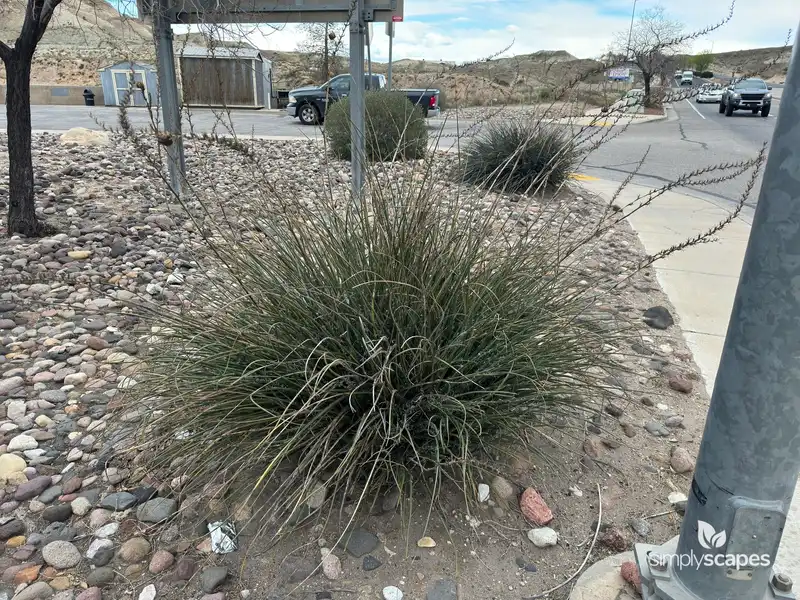
Yucca Plant
Hesperaloe parviflora
Vibrant red flower spikes and arching foliage for effortless desert beauty.
- Plant Type
- House Plants & Tropicals
- Width
- 3-6 Ft.
- Height
- 3-5 Ft.
- USDA hardiness zone
- 5 - 10
- Sun requirements
- Full Sun
- Design image count
- 17
Design images (17)


Bring your vision to life
The design images above are drag-and-drop ready — place this plant on a photo of your own yard and see it before you plant it.
Create design onlineAbout Yucca Plant
Hesperaloe parviflora, commonly called red yucca, forms evergreen clumps of narrow, arching blue-green leaves edged with fine white fibers. Red, coral, or pink tubular flowers rise on tall stalks and attract hummingbirds and butterflies.
### Site and seasonal interest
Choose full sun and sharply drained soil; this desert native handles heat and drought after establishment but is vulnerable to root rot in persistently damp ground. North Carolina Extension gives a mature height of 3–5 feet and spread of 4–6 feet, while Oregon State University describes the species as about 3–6 feet high and wide, including its flower stalks. Bloom generally runs from late spring into summer, with timing varying by climate.
### Garden use
Use it in a dry or rock garden, as a repeated mass planting, or in a large container with excellent drainage. The foliage forms a low fountain-like mound, while flowering stalks add vertical color above it. Its evergreen leaves keep structure through the year and may take on purple or reddish tones in cold weather.
## Maintenance
Water new plants until established, then water sparingly and allow the soil to dry between applications. Remove spent flower stalks and old leaves as needed, using care around the stiff leaf tips. [North Carolina Extension Gardener Plant Toolbox](https://plants.ces.ncsu.edu/plants/hesperaloe-parviflora/common-name/yellow-yucca/) · [Oregon State University Landscape Plants](https://landscapeplants.oregonstate.edu/plants/hesperaloe-parviflora)
## Napa County Firewise source
[Napa County](https://www.napacounty.gov/3373/Defensible-Space-Firewise-Planting) lists red yucca (*Hesperaloe*) among suggested Firewise plants. This plant represents the county's broad entry; the county does not identify every species or cultivar assessed. Check local suitability and invasive-plant guidance, and follow the county's site selection and maintenance advice. No plant is fireproof.
The 2025 Yavapai County guide lists Hesperaloe parviflora or its common-name group among fire-resistant plants; follow the source's placement, irrigation and maintenance guidance.
## Yavapai County — 2025 source scope and care
The [University of Arizona Yavapai County bulletin](https://extension.arizona.edu/sites/default/files/2025-03/FirewisePlants3-14-2025.pdf), page 2, lists Red yucca with the botanical cell Hesperaloe and form P. It places this entry in its fire-resistant list. The matched catalog name is Hesperaloe parviflora. This plant or genus is a narrower or broader source-group representative; the bulletin does not name or individually assess every species or cultivar.
Source form codes: C=groundcover, G=grass, P=perennial, S=shrub, T=tree and V=vine. Printed names and form codes can include source spelling errors or historical taxonomic treatments; the source wording is retained separately from the catalog name and plant-specific habit.
The bulletin states that resistant plants require irrigation and frequent maintenance. It describes low shrubs or clean taller shrubs with little dead material. Maintain suitable moisture and spacing, remove dead growth and avoid continuous fuel; a regional list does not establish every selection's performance or local cold hardiness.
No plant is fireproof. Keep this Yavapai classification separate from Arizona UA, Utah, New Mexico, Idaho, Colorado and other source ratings and their placement, moisture and maintenance conditions.
## Pacific Northwest — PNW 590 (2023): Texas red yucca
The [broadleaf-evergreens-9 profile](https://extension.oregonstate.edu/gallery/fire-resistant-plant-profiles-broadleaf-evergreens) provides this source context. Primary heading: Hesperaloe parviflora. Exact source taxon.
Source care: Low water use; Full sun. Use dry, sandy, well-drained soil. This is Hesperaloe, not a generic Yucca identity despite the catalog display name.
Profile reference data: Height: 30–36 inches; Spread: 4–6 feet; USDA hardiness zones: 5–10; Flowers: Red to pink; Bloom time: May–July. These are the publication's profile-level reference values; they are not independent measurements of each named example or a change to this catalog record's scalar fields. Availability of native forms, pollinator use and deer resistance remain source-scope statements, not automatic attribute tags.
The [2023 guide](https://extension.oregonstate.edu/catalog/pnw-590-fire-resistant-plants-home-landscapes) requires healthy, adequately watered plants and removal of dead/spent material. Keep the first 5 feet around the home free of plants; in the 5–30-foot zone separate planting groups by at least 10 feet, farther on slopes. Avoid continuous rows and ladder fuels, and keep tree branches at least 15 feet from the home. Source association is not a laboratory flammability score or a claim of fireproofness. This paragraph identifies 2023 scope; older PNW associations and other regional ratings remain separate.