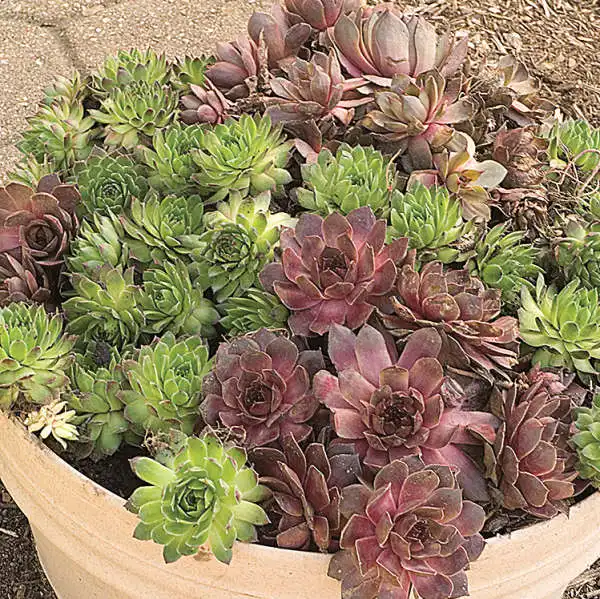
Hens & Chicks Plant
Sempervivum
Resilient, colorful rosettes that form stunning, low-maintenance groundcover mats.
- Plant Type
- Succulents
- Width
- 6-18 In.
- Height
- 3 In.
- USDA hardiness zone
- 3 - 8
- Sun requirements
- Full Sun
- Design image count
- 1
Design images (1)

Bring your vision to life
The design images above are drag-and-drop ready — place this plant on a photo of your own yard and see it before you plant it.
Create design onlineAbout Hens & Chicks Plant
Sempervivum, or houseleeks, are low-growing plants with colorful evergreen rosettes. Species and cultivars vary in foliage color, form and flowers; the RHS describes summer flower stalks with starry blooms in several colors.
## Growing conditions
Choose an open sunny position with well-drained soil. The RHS notes that houseleeks tolerate drought and extremes of temperature, but dislike shade, overly fertile soil and poor drainage. Use the genus in rock or gravel gardens, green roofs and containers, while allowing for variation among selections.
## Appearance and use
Many houseleeks form green, grey or purplish-red rosettes, and some develop white cobweb-like hairs. Their low geometric forms suit rock gardens, gravel planting and containers. [Royal Horticultural Society](https://www.rhs.org.uk/plants/sempervivum)
## Maintenance
Flowered rosettes die after blooming; stolons carry small offsets that can replace them. Keep the site open and free-draining, and protect only species that are especially vulnerable to winter wet.
## Pacific Northwest Firewise source
The [PNW 590 guide](https://extension.oregonstate.edu/gallery/fire-resistant-plant-profiles-groundcovers) profiles hens and chicks (Sempervivum) as a broad group of low-growing succulent rosettes. This genus-level tag does not establish that every species or cultivar was individually assessed. Keep groundcovers spaced and follow local site and maintenance guidance.
## FireSmart BC placement
The [FireSmart BC plant chart](https://firesmartbc.ca/landscaping-hub/fire-resistant-plants/) lists Sempervivum at genus level in the Intermediate zone. This broad listing does not independently rate every species or cultivar. Follow its placement and maintenance guidance.
## Colorado CSU/CSFS 2025 source
The [July 2025 Ignition-Resistant Landscape Plants guide](https://csfs.colostate.edu/wp-content/uploads/2025/08/CSFS_CSU-Ext_Fact-Sheets_IRLP_2025_081825-2_web_accessible.pdf) lists Sempervivum spp. in its non-native low-water flowers and groundcovers table and assigns ignitability score 10. In this system, 10 is least ignitable. This is the corresponding genus-level record; the table does not establish independent testing of every species or named cultivar.
For this source row, water needs are low to medium, the site is sun or partial sun, approximate height is 0.5 feet, and the stated elevation range is 5-10 thousand feet. These are the guide's example conditions, not universal dimensions or care requirements for every member of the genus. Keep plants appropriately watered, remove dead material, preserve spacing and avoid fuel connections. No plant is fireproof; use the guide's placement and maintenance instructions.
## New Mexico NMSU Fire Wise source
The [Fire Wise Plant Materials guide](https://www.emnrd.nm.gov/sfd/wp-content/uploads/sites/4/FireWisePlantMaterialsNMSU.pdf), page 6, lists Sempervivum sp. (Hen and chicks) in its flowers and groundcovers table. This genus association does not establish individual assessment or identical fire behavior for every species or cultivar. For this source row, water is low to moderate, exposure is S/PS, approximate height is .5 feet, and the estimated bloom period is n/a. Its exposure key defines S as full sun, PS as partial sun and Sh as shade. These are source-row examples, not universal dimensions or care for the whole group. The elevation cells, in thousands of feet, are 4: Y; 5: Y; 6: Y; 7: Y; 8: Y; 9+: Y. Y means yes, N not recommended and ? unknown or doubtful; a blank cell is unspecified, not approval. These elevations are separate from USDA hardiness zones. No plant is fireproof. Maintain moisture and separated planting groups, prevent fuel continuity, and remove dead vegetation and litter. Keep other regional ratings and conditions separate.
## Pacific Northwest — PNW 590 (2023): Hens and chicks
The [groundcovers-20 profile](https://extension.oregonstate.edu/gallery/fire-resistant-plant-profiles-groundcovers) provides this source context. Primary heading: Sempervivum species. Exact source genus scope; no individual species/cultivar testing inferred.
Source care: Low water use; Full sun to partial shade. The source concerns low rosette-forming groundcovers. Maintain separated mats and clear dead parent rosettes and spent flower stalks.
Profile reference data: Height: 2–6 inches; Spread: 6–10 inches; USDA hardiness zones: 4–10; Flowers: pink; Bloom time: June–August. These are the publication's profile-level reference values; they are not independent measurements of each named example or a change to this catalog record's scalar fields. Availability of native forms, pollinator use and deer resistance remain source-scope statements, not automatic attribute tags.
The [2023 guide](https://extension.oregonstate.edu/catalog/pnw-590-fire-resistant-plants-home-landscapes) requires healthy, adequately watered plants and removal of dead/spent material. Keep the first 5 feet around the home free of plants; in the 5–30-foot zone separate planting groups by at least 10 feet, farther on slopes. Avoid continuous rows and ladder fuels, and keep tree branches at least 15 feet from the home. Source association is not a laboratory flammability score or a claim of fireproofness. This paragraph identifies 2023 scope; older PNW associations and other regional ratings remain separate.