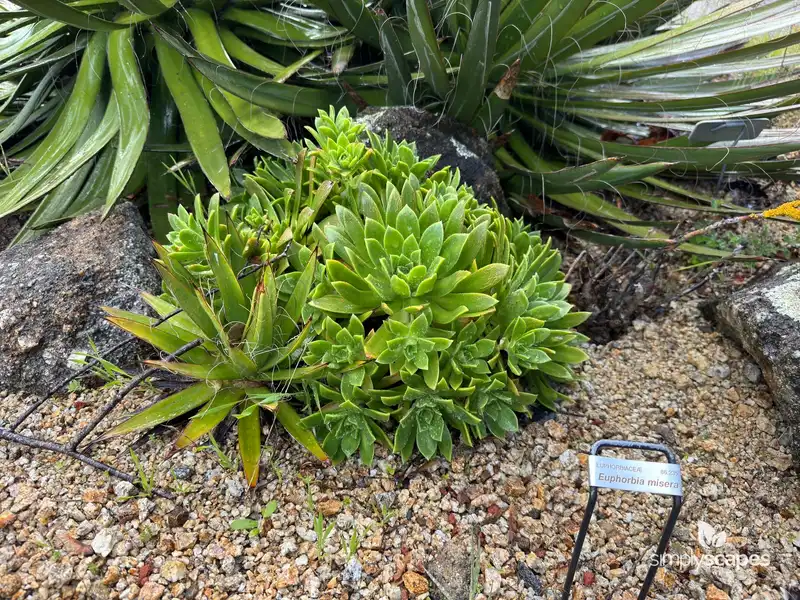
Agave Plant
Agave
Iconic architectural succulents with dramatic rosettes and low water needs.
- Plant Type
- Succulents
- Width
- 3-15 Ft.
- Height
- 2-10 Ft.
- USDA hardiness zone
- 5 - 11
- Sun requirements
- Full Sun, Part Shade
Bring your vision to life
The design images above are drag-and-drop ready — place this plant on a photo of your own yard and see it before you plant it.
Create design onlineAbout Agave Plant
Agave is a diverse genus of rosette-forming succulents, ranging from compact container plants to large landscape specimens. Species differ widely in leaf shape, color, spines, mature size, flowering interval, and cold tolerance, so choose a species that fits the site rather than assuming one profile applies to all agaves.
## Garden Character
Thick evergreen leaves form a bold, coarse-textured rosette; some have sharp marginal teeth or tips, while others are smooth. Flowers rise on tall stalks after many years, and most rosettes flower once before declining. Many also produce offsets that continue growing. The University of Florida reports a broad genus-level range of about 2–10 feet tall and 3–15 feet wide, with flower stalks that may reach 20 feet depending on species.
## Growing Conditions
Most agaves do best in full sun and sharply drained soil; some tolerate partial shade. Allow the soil to dry between waterings, especially in cool weather. The [UF/IFAS Agave guide](https://ask.ifas.ufl.edu/publication/FP022) describes strong drought tolerance and little irrigation once established. It also notes that hardiness depends on species selection. Use a large container or place landscape forms where their mature spread and any sharp leaves will not obstruct a path. See also the [RHS Agave growing guide](https://www.rhs.org.uk/plants/agave?type=0).
## Maintenance
Remove offsets only when needed to control a clump or propagate a plant. Once a rosette flowers and declines, leave or replant suitable offsets to continue the planting. Wear gloves when handling spiny types.
The 2025 Yavapai County guide lists Agave at genus scope among fire-resistant plants. The source does not individually assess every species or cultivar; follow its placement, irrigation and maintenance guidance.
## San Luis Obispo County — January 2014
The [County-Approved Plant List](https://www.slocounty.ca.gov/departments/planning-building/forms-documents/environmental-forms-and-documents/plants-information/county-approved-plant-list) rates Agave varieties at F2: its most fire-retardant planting category, for 30–70 feet from a structure. This is the source’s group-level listing, not independent testing of every species or named cultivar. Follow the county’s conditions for plant health, watering and fire-buffer design: avoid overcrowding, remove dead material, maintain separate planting groups and prevent ground-to-canopy fuel connections. Keep other regional source ratings and their placement instructions separate; the county categories are not a universal flammability scale.
## Yavapai County — 2025 source scope and care
The [University of Arizona Yavapai County bulletin](https://extension.arizona.edu/sites/default/files/2025-03/FirewisePlants3-14-2025.pdf), page 1, lists Agave with the botanical cell Agave sp. and form P. It places this entry in its fire-resistant list. The matched catalog name is Agave.
Source form codes: C=groundcover, G=grass, P=perennial, S=shrub, T=tree and V=vine. Printed names and form codes can include source spelling errors or historical taxonomic treatments; the source wording is retained separately from the catalog name and plant-specific habit.
The bulletin states that resistant plants require irrigation and frequent maintenance. It describes low shrubs or clean taller shrubs with little dead material. Maintain suitable moisture and spacing, remove dead growth and avoid continuous fuel; a regional list does not establish every selection's performance or local cold hardiness.
No plant is fireproof. Keep this Yavapai classification separate from Arizona UA, Utah, New Mexico, Idaho, Colorado and other source ratings and their placement, moisture and maintenance conditions.