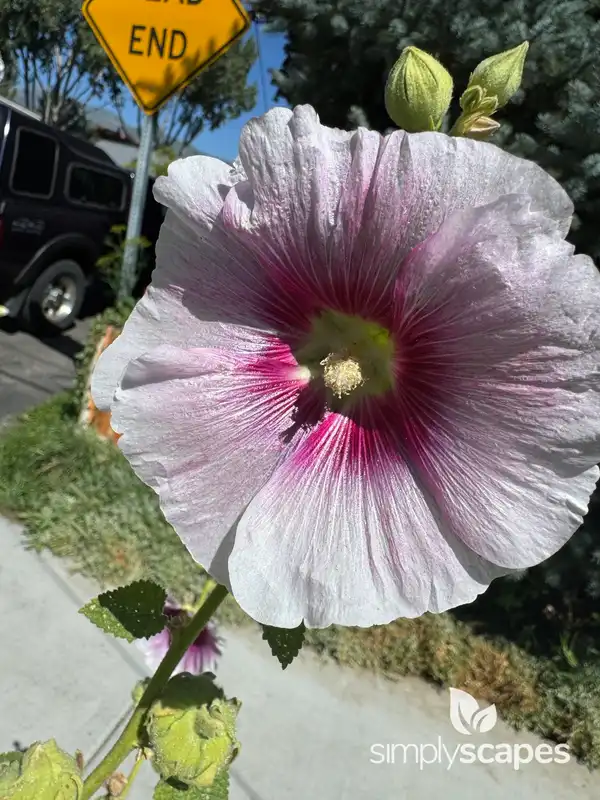
Hollyhock
Alcea rosea
Stately towers of vibrant blooms, perfect for a classic cottage garden.
- Plant Type
- Perennials & Annuals
- Width
- 1-2 Ft.
- Height
- 6-8 Ft.
- USDA hardiness zone
- 3 - 9
- Sun requirements
- Full Sun, Part Shade
- Design image count
- 10
Design images (10)


Bring your vision to life
The design images above are drag-and-drop ready — place this plant on a photo of your own yard and see it before you plant it.
Create design onlineAbout Hollyhock
Alcea rosea, the common hollyhock, is a biennial or short-lived perennial that sends tall spikes of open, funnel-shaped flowers above a broad basal rosette. It brings a strong vertical accent to cottage gardens, sunny borders and wall-side plantings, with flowering colors that vary among seed-grown plants and cultivars.
## Form and season
The [North Carolina Extension Plant Toolbox](https://plants.ces.ncsu.edu/plants/alcea-rosea/) describes hollyhock as an annual-to-biennial Malvaceae plant, commonly 5–8 feet tall and 1–2 feet wide, with flowers from June through August. The [RHS profile](https://www.rhs.org.uk/plants/87168/althaea-rosea/details) describes a robust biennial or short-lived perennial, with summer racemes of flowers that may be pink, purple, red, white or yellow. Plants may reseed, so seedlings can appear in later seasons; colors and lifespan are not necessarily uniform in a mixed planting.
## Siting
Grow in full sun in moderately fertile, well-drained soil. Hollyhocks tolerate a range of soil textures, but crowded, damp foliage can favor disease. The tall flowering stems suit the back of a border; give plants room for air movement and allow for their height. Support may be useful in exposed sites even though sturdy stems often stand without staking.
## Maintenance
Water young plants through establishment and during prolonged dry weather, preferably at soil level. Watch for hollyhock rust, which can mark leaves with orange or brown pustules, especially in wet summer conditions. Remove affected or spent foliage and clear diseased debris rather than leaving it around the planting; remove or retain flower stems after bloom depending on whether you want to limit or encourage self-seeding.