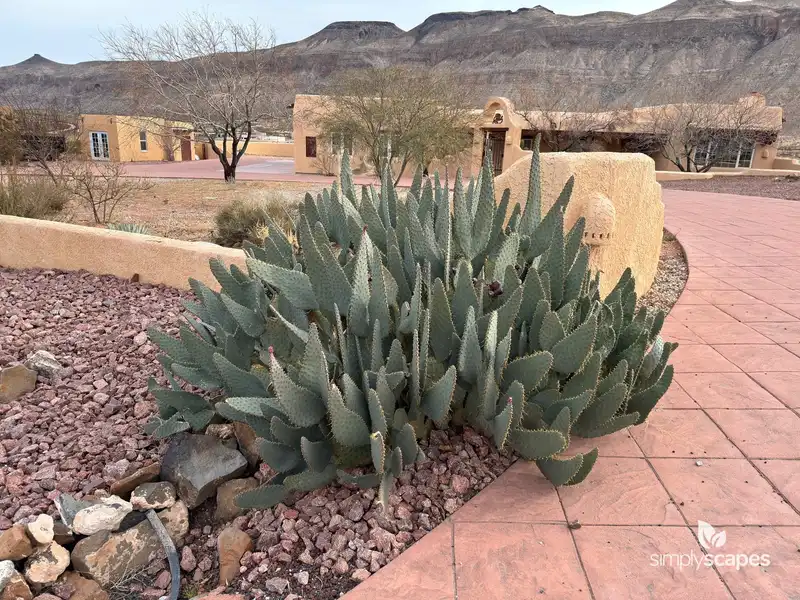
Beavertail Cactus
Opuntia basilaris
A low, clumping prickly pear with blue-gray pads and pink-to-magenta spring flowers.
- Plant Type
- Succulents
- Width
- 6 Ft.
- Height
- 24 In.
- USDA hardiness zone
- 7 - 10
- Sun requirements
- Full Sun
- Design image count
- 4
Design images (4)


Bring your vision to life
The design images above are drag-and-drop ready — place this plant on a photo of your own yard and see it before you plant it.
Create design onlineAbout Beavertail Cactus
Beavertail cactus (Opuntia basilaris) is a low-clumping prickly pear native to arid parts of the Southwest. Its blue-gray flattened pads create a sculptural silhouette, and it bears showy pink-to-magenta blooms in spring and early summer. [University of Arizona Cooperative Extension](https://yavapaiplants.extension.arizona.edu/opuntia-basilaris) documents this species’ low habit, 2-foot height, 6-foot spread and desert habitats.
## Garden use
Use Beavertail in a sunny rock garden, dry planting or open gravel bed where the broad clump can spread without obstructing a path. The gray-blue pads offer strong texture throughout the year, while seasonal flowers bring bright color in spring. It is native to Arizona and occurs in desert scrub, grassland, chaparral and pinyon-juniper communities.
## Growing
The species grows on desert plains, dry mountain slopes and in washes. Its pads are flat and jointed, typically blue-gray, and new pads arise from the base of older ones. The University of Arizona profile reports flowers from March through June. Cold tolerance varies among cacti, so use a locally appropriate site and protect the plant from conditions outside its proven range.
## Maintenance
Avoid planting where people or pets will brush against the pads. Though the species lacks prominent long spines, its surfaces and fruit carry small glochids—barbed, hair-like bristles that can lodge in skin. Wear thick gloves and use tools when removing pads or clearing debris. Allow the soil to dry between irrigations and avoid standing water around the roots.
## Pacific Northwest Firewise source
The [PNW 590 guide](https://extension.oregonstate.edu/gallery/fire-resistant-plant-profiles-perennials) lists prickly pears as a broad group. Beavertail cactus is one representative; select cactus for local cold hardiness. Its catalog zone range is 7–10 and its glochids require care. Follow local site and maintenance guidance.
## Pacific Northwest — existing-association scope reconciliation
The [2023 Prickly pear cactus profile](https://extension.oregonstate.edu/gallery/fire-resistant-plant-profiles-perennials) prints Opuntia spp.. This record's preexisting PNW tag is retained with status: narrower source-group representative. Beavertail is a narrower Opuntia species. Its actual cold hardiness and suitability must meet the source's instruction to select locally winter-hardy forms; genus inclusion is not species-specific test evidence.
Source care context: Low water use; Full sun to partial shade. Choose locally cold-hardy forms and account for spines, actual mature size and varied growth habits.
The retained tag is not an additional source recommendation, a blanket rating for every related taxon or proof of an exact photographed genotype. Profile dimensions and zone bands are not copied into this record as selection-specific measurements. The source's general native-form and wildlife statements do not assign those attributes to every record.
For current PNW placement and maintenance, keep the first 5 feet around the home free of plants; use healthy, adequately watered, maintained plantings in the 5–30-foot zone, with at least 10 feet between groups, farther on slopes. Avoid ladder fuels and continuous fuel rows, keep tree branches at least 15 feet from the home and remove dead/spent material. The 2023 placement advice does not convert an older or unresolved association into a current positive recommendation. No plant is fireproof.