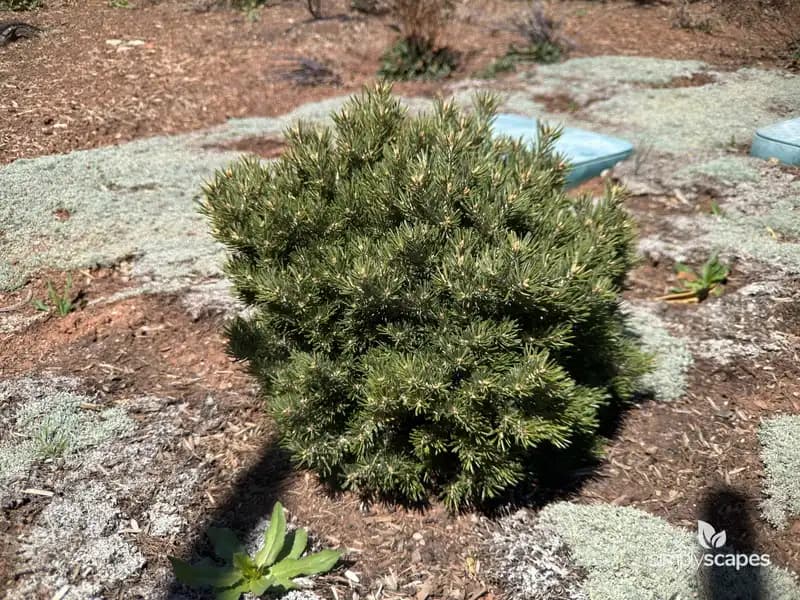
Pinyon Pine
Pinus edulis
A slow-growing, drought-tolerant evergreen famous for its delicious, edible pine nuts.
- Plant Type
- Conifer Trees
- Width
- 10-15 Ft.
- Height
- 30 Ft.
- USDA hardiness zone
- 4 - 8
- Sun requirements
- Full Sun
- Design image count
- 2
Design images (2)


Bring your vision to life
The design images above are drag-and-drop ready — place this plant on a photo of your own yard and see it before you plant it.
Create design onlineAbout Pinyon Pine
Pinyon Pine, *Pinus edulis*, is a slow-growing evergreen native to the southwestern United States. It produces edible, wingless seeds in woody cones and develops a broad, rounded crown; allow for the existing long-term catalog dimensions of about 30 feet tall and 10–15 feet wide.
## Form and Placement
Use this regional pine where its eventual canopy and root area have room, such as a sunny, dry-site planting. Utah State University Extension describes two-needle evergreen foliage, edible seeds, and natural occurrence on dry sites, and lists USDA zones 4–8. The [North Carolina Extension Gardener Plant Toolbox](https://plants.ces.ncsu.edu/plants/pinus-edulis/common-name/pinyon-pine/) documents the species’ names, mature form, and rocky-soil tolerance; the [US Forest Service](https://research.fs.usda.gov/feis/species-reviews/pinedu) reports typical mature heights of 26–56 feet.
## Growing Conditions
Choose full sun and well-drained soil. In its native range this pine often grows with junipers on dry sites; garden plants can struggle where irrigation is excessive or roots are disturbed. Water deeply during establishment, then avoid frequent shallow watering.
## Maintenance
Keep mulch away from the trunk and protect the root zone from compaction. Allow natural litter to remain where practical, and give the tree space to form its mature crown. Seed production varies from year to year and is affected by water stress.
The 2025 Yavapai County guide lists pinyon pine among fire-prone plants. This record represents the source's broad entry; it does not establish an individual assessment of every species or cultivar. Follow its placement and maintenance guidance.
## Yavapai County — 2025 source scope and care
The [University of Arizona Yavapai County bulletin](https://extension.arizona.edu/sites/default/files/2025-03/FirewisePlants3-14-2025.pdf), page 3, lists Pinion with the botanical cell Pinion and form T. It places this entry in its fire-prone list. The matched catalog name is Pinus edulis. The source uses Pinion as both common and species wording. Pinus edulis is a qualified pinyon-pine representative; the source does not identify every pinyon taxon.
Source form codes: C=groundcover, G=grass, P=perennial, S=shrub, T=tree and V=vine. Printed names and form codes can include source spelling errors or historical taxonomic treatments; the source wording is retained separately from the catalog name and plant-specific habit.
The bulletin warns that fire-prone plants can ignite readily and burn intensely, and should be removed or aggressively maintained when near a home, road or driveway. For native trees it calls for removing dead material, keeping limbs out of the lower 6–10 feet and clearing shrubs beneath the canopy. For other fire-prone natives it calls for isolated stands more than 30 feet from structures. Apply current local requirements and pruning suited to the identified plant.
No plant is fireproof. Keep this Yavapai classification separate from Arizona UA, Utah, New Mexico, Idaho, Colorado and other source ratings and their placement, moisture and maintenance conditions.