Why Leaves Change Color in Fall and How to Design for All Four Seasons
See what gives fall leaves their color, then use those seasonal changes to plan a yard with something to enjoy all year.
The same Utah canyon that looked green in August can glow gold and red a few weeks later. Quaking aspens turn golden, while bigtooth maples can bring out the reds and oranges. The shift starts inside each leaf, and it offers a lesson for your own yard. A plant’s best season might come long after its flowers are gone. Utah State University Extension
What happens inside a leaf in fall?
During spring and summer, leaves are full of chlorophyll. This green pigment helps plants capture sunlight for photosynthesis, the process they use to make sugars. As days shorten in fall, many deciduous trees slow down chlorophyll production. As the remaining chlorophyll breaks down, the green fades.
That’s when yellow and orange pigments called carotenoids become easier to see. They were in the leaf all along. Many reds and purples come from anthocyanins, which some trees make in their leaves during fall. As the tree prepares to shed its leaves, a separation layer forms at the base of each leaf stem. Eventually the leaf detaches. U.S. Forest Service
Why are some years more colorful than others?
Shorter days help set the timing, and weather influences how vivid the display becomes. Sunny days followed by cool nights above freezing can bring out stronger reds in some trees. A hard freeze can shorten the show, and drought can affect its timing. That’s one reason the same maple can look different from one October to the next. U.S. Forest Service
Give your yard something to look forward to in every season
Start with a spot you see every day, like the bed beside your front walk or the view from your kitchen window. Think about what will catch your eye there in each season.
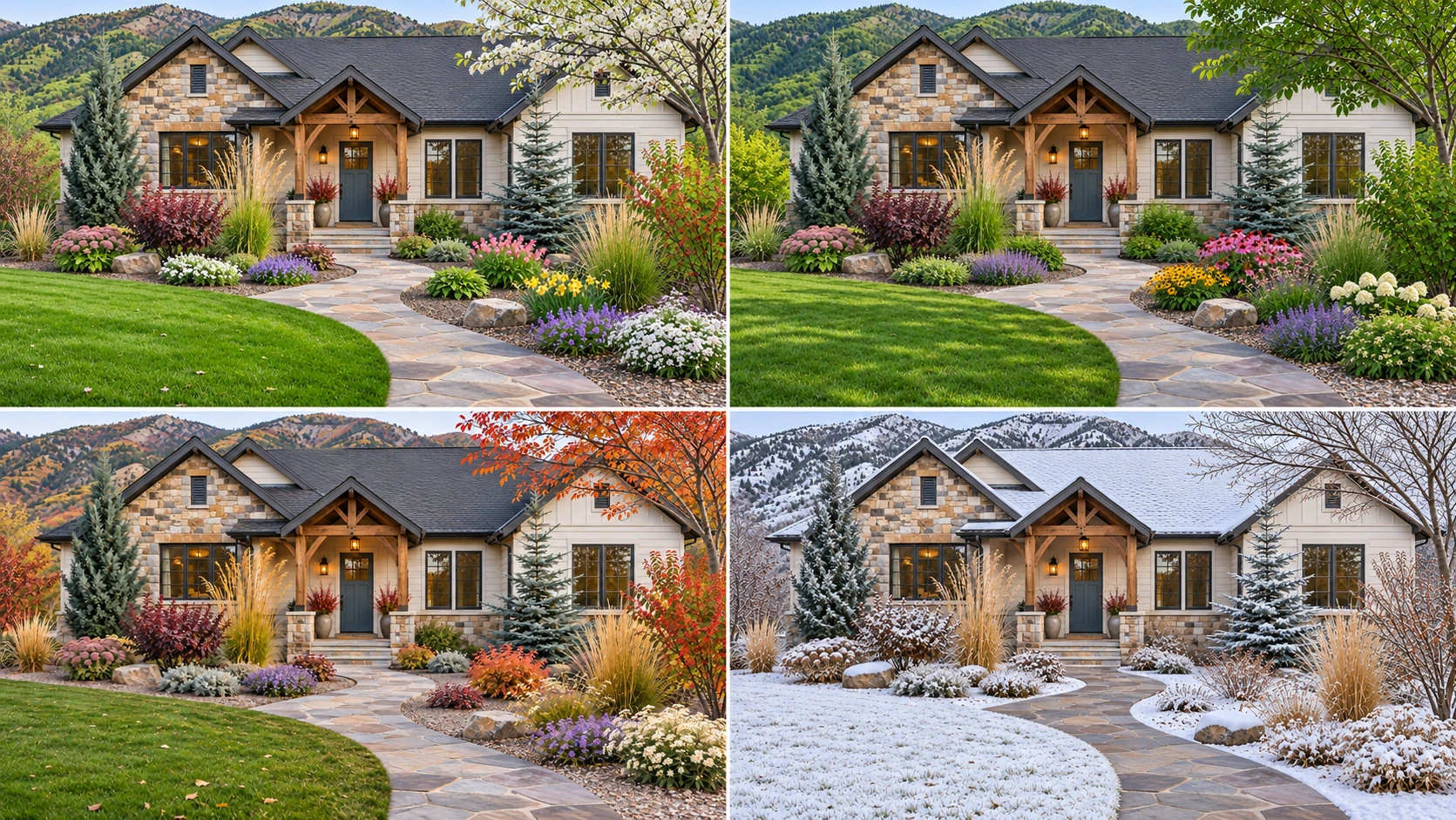
Watch the tree on the right change from white spring blossoms to green summer leaves, orange fall foliage, and bare winter branches. Evergreens and upright grasses keep their shape against the snow.
- Spring — A spring-flowering tree and low blooms to brighten the front walk.
- Summer — A leafy green canopy and colorful flowering plants along the walk.
- Fall — A tree or shrub with bold fall foliage to bring red and orange above the planting beds.
- Winter — Snow-dusted evergreens, upright ornamental grasses, and bare branches to give the garden shape.
A simple combination could start with a shrub for spring flowers and fall foliage, add a summer-blooming perennial, and finish with an evergreen to give the bed shape through winter. Choose plants for the sunlight, water, and space they’ll have at maturity. Utah State University Extension
Try it on a photo of your own yard
Open the SimplyScapes Visual Designer and start with a photo of your space. Explore the plant library, then drag plants onto your photo to try different combinations. Start with one planting bed and give each season its own moment, from the first spring flowers to the evergreens you’ll see out the window in January.
Ready to put this into practice?
Start with AI on a photo of your own yard, then place every plant yourself. Free to start.
No credit card required. Free plan limits apply.
Related Articles

Start designing your landscape today
Turn what you have learned into a visual design. SimplyScapes gives you professional-grade tools — free to start, no credit card required.
Free forever. No credit card required.