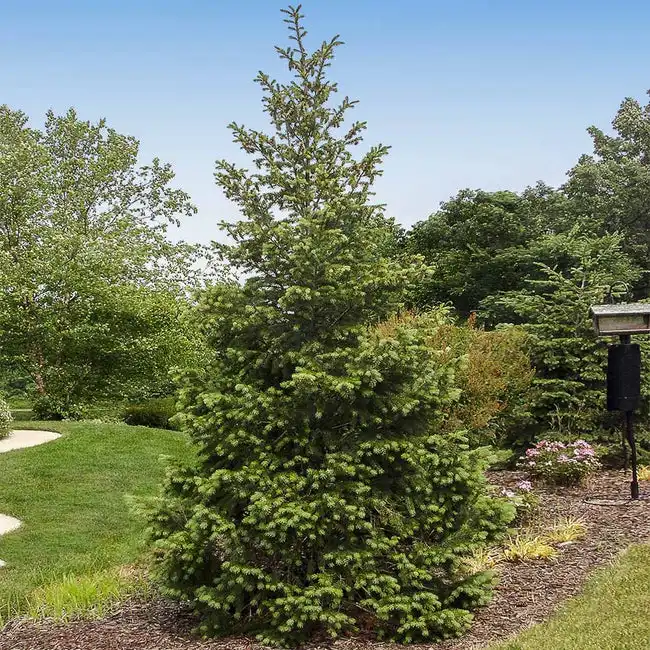
Fir Trees
Abies
Elegant, symmetrical evergreens with fragrant foliage, perfect for grand landscapes and holidays.
- Plant Type
- Conifer Trees
- Design image count
- 4
Design images (4)


Bring your vision to life
The design images above are drag-and-drop ready — place this plant on a photo of your own yard and see it before you plant it.
Create design onlineAbout Fir Trees
Fir (Abies) is a genus of evergreen conifers, not a single landscape cultivar. Its species span temperate regions across the Northern Hemisphere, so mature size, hardiness, foliage color, water needs, and landscape fit must be checked for the exact species or cultivar.
## Identification and landscape use
The Royal Botanic Gardens, Kew currently recognizes 49 accepted species in *Abies*. True firs belong to the pine family, Pinaceae, and are grown as specimen trees, screening, and shelter where the selected species has enough space and the right climate. Some species are towering forest trees, while selected cultivars stay compact; the genus name alone does not predict a useful garden size. This record is a genus-level reference, not a planting specification.
## Choosing a species
Kew records the genus across temperate Eurasia to northern Indochina and North America to Honduras. That broad range reflects substantial variation in climate and habitat. A specialist overview from [Trees and Shrubs Online](https://www.treesandshrubsonline.org/articles/abies/) notes that most firs need well-drained soil and that heat, humidity, and drought responses differ among species and provenances. Before specifying one, check its mature dimensions, local hardiness, summer climate, drainage, and tolerance of the intended exposure. Use the species or named-cultivar record for those decisions; do not apply one zone, water rating, or size to all firs.
## Sources
- [Plants of the World Online: *Abies*](https://powo.science.kew.org/taxon/urn:lsid:ipni.org:names:325655-2) — accepted name, species count, and native range.
- [Trees and Shrubs Online: *Abies*](https://www.treesandshrubsonline.org/articles/abies/) — genus overview and cultivation context.
## Maintenance
Maintenance depends on the species and site. Allow room for the selected fir’s eventual canopy and preserve its natural form rather than routinely shearing it. Provide establishment water and later irrigation according to local rainfall, soil drainage, and species-specific guidance. Because this is a genus-level entry, it intentionally has no universal watering or pruning schedule; consult a regional extension service or botanical garden for the chosen taxon.
The 2025 Yavapai County guide lists Abies at genus scope among fire-prone plants. This is a fire-hazard warning, not an individual assessment of every species or cultivar. Follow the guide's placement and maintenance guidance.
## FireSmart BC hazard warning
[FireSmart BC](https://firesmartbc.ca/landscaping-hub/fire-resistant-plants/#fire-hazards) lists Abies as Highest Risk in its fire hazard table. This is a broad genus-level warning, not an individual assessment of every species or cultivar; follow local placement and maintenance guidance.
## Yavapai County — 2025 source scope and care
The [University of Arizona Yavapai County bulletin](https://extension.arizona.edu/sites/default/files/2025-03/FirewisePlants3-14-2025.pdf), page 3, lists Fir with the botanical cell Abies sp. and form T. It places this entry in its fire-prone list. The matched catalog name is Abies.
Source form codes: C=groundcover, G=grass, P=perennial, S=shrub, T=tree and V=vine. Printed names and form codes can include source spelling errors or historical taxonomic treatments; the source wording is retained separately from the catalog name and plant-specific habit.
The bulletin warns that fire-prone plants can ignite readily and burn intensely, and should be removed or aggressively maintained when near a home, road or driveway. For native trees it calls for removing dead material, keeping limbs out of the lower 6–10 feet and clearing shrubs beneath the canopy. For other fire-prone natives it calls for isolated stands more than 30 feet from structures. Apply current local requirements and pruning suited to the identified plant.
No plant is fireproof. Keep this Yavapai classification separate from Arizona UA, Utah, New Mexico, Idaho, Colorado and other source ratings and their placement, moisture and maintenance conditions.