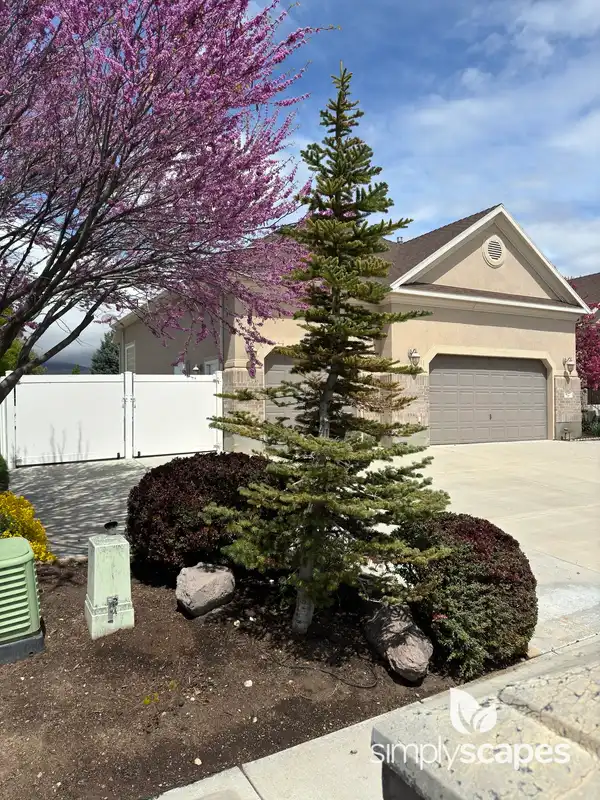
Sub Alpine Fir
Abies lasiocarpa
A slender, spire-like evergreen with stunning silvery-blue needles for cool climates.
- Plant Type
- Conifer Trees
- Width
- 10-20 Ft.
- Height
- 60-90 Ft.
- USDA hardiness zone
- 4 - 7
- Sun requirements
- Full Sun, Part Shade
- Water requirements
- Medium
Bring your vision to life
The design images above are drag-and-drop ready — place this plant on a photo of your own yard and see it before you plant it.
Create design onlineAbout Sub Alpine Fir
Subalpine fir (*Abies lasiocarpa*) is a narrow, spire-shaped evergreen native to cool mountain regions of western North America. Its dense blue-green needles and upright purple cones provide year-round structure, but its best landscape form depends on a cool climate and consistent soil moisture.
## Landscape role
Use it as a specimen or a screen in a naturalistic high-elevation conifer planting. The species develops a dense, narrow, sharply pointed crown; plants at exposed timberline can become low and wind-shaped. Mature trees may reach about 100 feet in favorable sites, so allow generous overhead and root-zone space. North Carolina State Extension lists screening among its landscape uses. This is the typical subalpine fir entry; corkbark fir (*A. lasiocarpa* var. *arizonica*) is a distinct record.
## Growing conditions
Choose full sun or partial shade in a cool-summer climate. Subalpine fir is adapted to high-elevation conditions and can lose its natural outline in warmer lowland gardens. It grows across several soil types, but does best in moist, well-drained soil; North Carolina State Extension favors acidic soil, while USDA silvics reports that saturated, shallow, and coarse soils can limit growth. The cited horticultural guidance spans USDA Zones 4–7; local provenance, summer heat, and exposure affect performance. Do not classify it as drought tolerant.
## Identity and sourcing
This is a botanical species listing, not a branded cultivar, so a named breeder, brand, or cultivar-specific patent does not apply. Its native range extends from Alaska and Yukon south into the western mountains.
## Sources
- Foliage, mature height, shade, and regional garden performance: [Oregon State University Landscape Plants](https://landscapeplants.oregonstate.edu/plants/abies-lasiocarpa).
- Landscape use, growth rate, maintenance, soil, and hardiness: [North Carolina State Extension](https://plants.ces.ncsu.edu/plants/abies-lasiocarpa/common-name/subalpine-fir/).
- Taxonomy, native range, soil response, and mountain ecology: [USDA Forest Service, Silvics of North America](https://research.fs.usda.gov/silvics/subalpine-fir).
## Maintenance
Water regularly during establishment and avoid prolonged soil drying, especially in warm climates. Maintain good drainage and reserve pruning for dead or damaged branches; routine shaping is usually unnecessary in a site where the tree grows well.