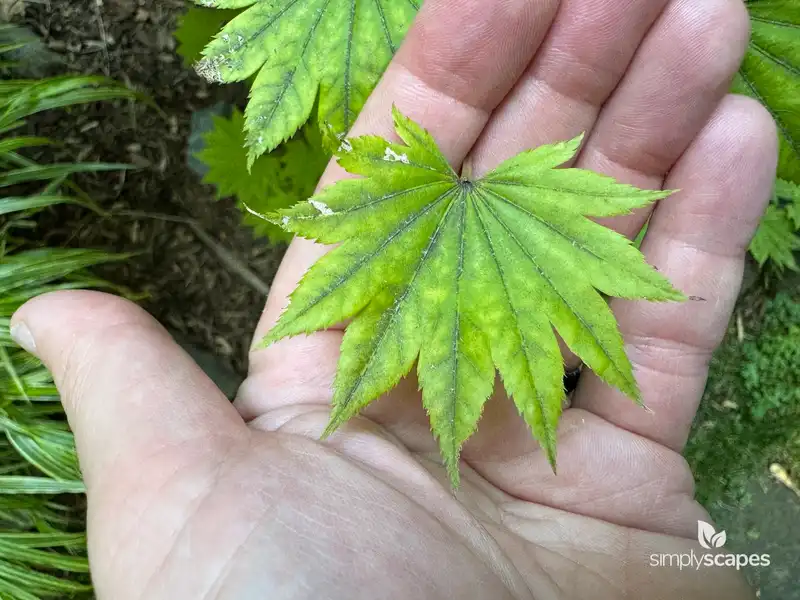
Vine Maple Tree
Acer circinatum
The Pacific Northwest's elegant alternative to Japanese Maples.
- Plant Type
- Shade Trees
- Width
- 15–20 ft.
- Height
- 10–25 ft.
- USDA hardiness zone
- 4 - 7
- Sun requirements
- Full Sun, Part Shade, Full Shade
- Water requirements
- Medium
- Design image count
- 1
Design images (1)

Bring your vision to life
The design images above are drag-and-drop ready — place this plant on a photo of your own yard and see it before you plant it.
Create design onlineAbout Vine Maple Tree
Vine maple (*Acer circinatum*) is a Pacific Northwest native that grows as a small deciduous tree or large shrub with several stems and sculptural branching. Its form shifts with light: plants tend to stand more upright in brighter sites and develop a delicate, spreading outline beneath woodland canopy, while the leaves turn yellow, orange, and red in fall.
## Landscape use and character
Use vine maple in a shady border, woodland garden, patio setting, or small grouping where its branching structure can be seen. It typically reaches **10–25 feet tall and 15–20 feet wide**, so it fits where a full-size shade tree would overwhelm the space. Rounded leaves with seven to nine lobes emerge bright green, often with a reddish tint on new growth. Small greenish-white flowers appear in spring, followed by paired winged seeds that turn red or burgundy as they mature. The smooth young stems are green and become reddish-brown with age. [NC State Extension](https://plants.ces.ncsu.edu/plants/acer-circinatum/) details its size, seasonal color, and landscape uses; the [USDA plant guide](https://plants.usda.gov/DocumentLibrary/plantguide/pdf/pg_acci.pdf) describes its native range and value in riparian buffers.
## Growing conditions
This maple is suited to **USDA zones 4–7**. Partial shade and humus-rich, moist, well-drained soil support its best growth. It can grow in more sun where soil moisture is reliable, but NC State warns that it will not tolerate hot, dry conditions. Sandy or loamy soils with acidic to neutral pH are suitable. Keep new plantings evenly moist while roots establish and monitor soil during summer heat; do not treat this species as a low-water tree. Its flowers and seeds support pollinators and wildlife, and it is a particularly useful native choice in Pacific Northwest landscapes.
## Maintenance
Allow **moderate maintenance** for moisture checks and, where needed, spread management. Vine maple can form clumps; arching branches may root when they touch the ground, so inspect the edge of a contained planting and remove rooted stems if you want to limit its footprint. In a naturalized woodland or riparian buffer, that spreading habit can be useful. Preserve the layered form with selective removal of crossing or misplaced shoots. Avoid heavy shearing. If pruning is needed, do it during dormancy; see the [RHS growing guidance](https://www.rhs.org.uk/plants/180/acer-circinatum/details).