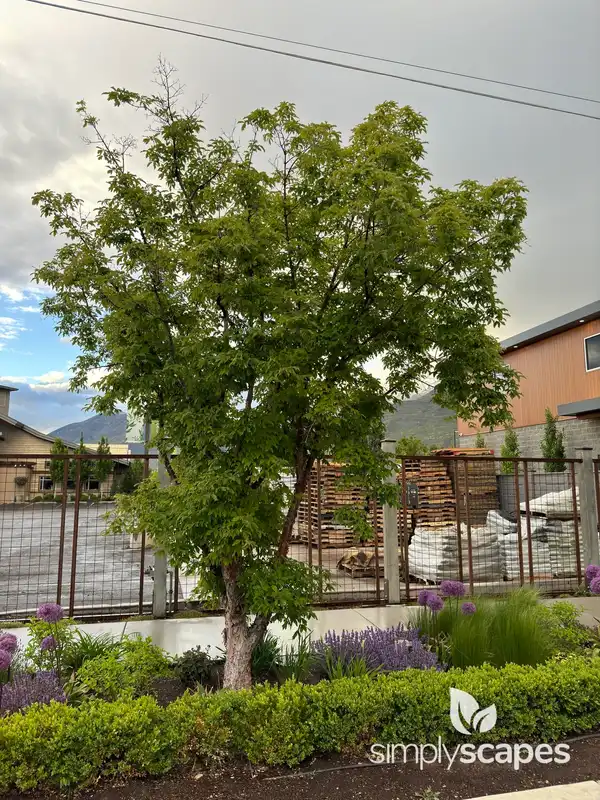
Box Elder Maple
Acer negundo
A fast-growing, resilient maple perfect for quick shade and naturalized areas.
- Plant Type
- Shade Trees
- Width
- 30–50 Ft.
- Height
- 30–50 Ft.
- USDA hardiness zone
- 3 - 9
- Sun requirements
- Full Sun, Part Shade
- Water requirements
- Medium
- Design image count
- 3
Design images (3)


Bring your vision to life
The design images above are drag-and-drop ready — place this plant on a photo of your own yard and see it before you plant it.
Create design onlineAbout Box Elder Maple
Boxelder (*Acer negundo*), also called Manitoba maple or ash-leaved maple, is a fast-growing North American native with light-green compound leaves and a broad, irregular canopy. It establishes quickly on riparian and reclaimed sites, but weak branches, abundant seedlings, suckers, and seed litter make the straight species a poor fit for many small or tightly maintained urban landscapes.
## Form and seasonal interest
Boxelder commonly reaches 30–50 feet tall and wide, with a rounded but often uneven crown. University of Florida IFAS gives a more compact landscape estimate of 40–50 feet tall by 30–40 feet wide. Its leaves are unusual for a maple: each is divided into three to five leaflets, sometimes more. They remain light green through summer; fall color varies from yellow to orange and may be modest in some regions. Small greenish flowers appear in early spring, often before the leaves. Male and female flowers generally occur on separate trees, and only female trees produce conspicuous hanging clusters of paired, winged seeds.
## Placement and growing conditions
Use it as a fast shade tree only where wide open space and cleanup can be accommodated, or in naturalized plantings, streambank stabilization, reclamation, and shelterbelts in an appropriate regional landscape. It grows in full sun or part shade and tolerates a wide range of soils, including clay, acidic or alkaline ground, and wet sites. The [Morton Arboretum lists USDA zones 3–9](https://mortonarb.org/plant-and-protect/trees-and-plants/boxelder/). Once established, boxelder tolerates dry conditions; newly planted trees still need water while roots develop. [University of Florida IFAS Extension rates aerosol salt tolerance as moderate](https://ask.ifas.ufl.edu/publication/ST020), which describes airborne salt rather than saline soil.
## Trade-offs and identity
Boxelder self-seeds aggressively and can naturalize in disturbed places outside its native range. Its wood and branch structure are weak, making limbs prone to storm and ice damage. Seedlings and root suckers need removal, while samaras and leaves create seasonal cleanup. The Morton Arboretum notes that boxelder bugs often gather on trees and may enter buildings in fall; avoid planting close to buildings, parking, sidewalks, or overhead utilities. UF/IFAS advises against using it as a street tree. This record is the straight species, not a branded cultivar, so cultivar breeder and patent information do not apply.
## Sources
- [The Morton Arboretum: Boxelder](https://mortonarb.org/plant-and-protect/trees-and-plants/boxelder/)
- [University of Florida IFAS Extension: Acer negundo](https://ask.ifas.ufl.edu/publication/ST020)
- [USDA Forest Service: Silvics of North America — Boxelder](https://research.fs.usda.gov/silvics/boxelder)
## Maintenance
Establish a sturdy framework with early structural pruning, then inspect major limbs after severe weather. Remove unwanted seedlings and root suckers while they are small; female trees can produce many samaras, so expect seasonal cleanup. Water during establishment and during prolonged dry spells. Keep the planting area clear of infrastructure because surface roots may develop.