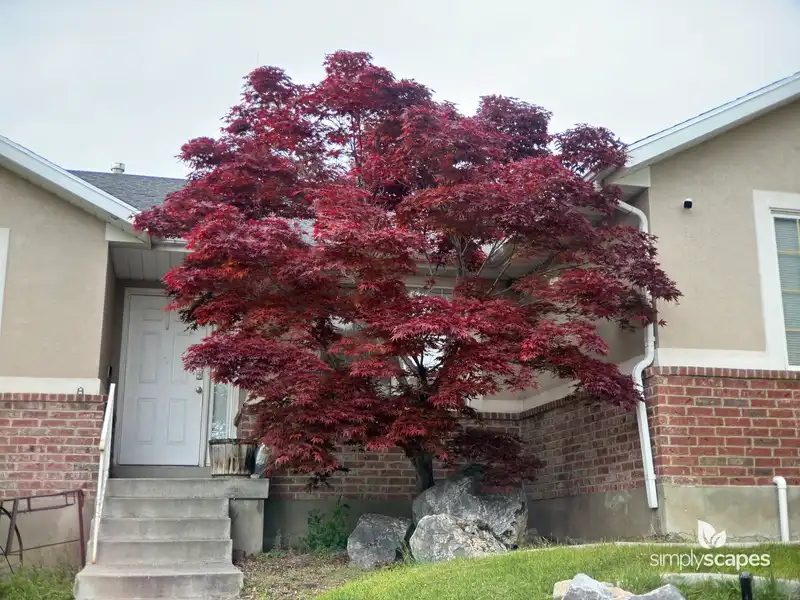
Japanese Maple Tree
Acer palmatum
An elegant, slow-growing tree with stunning fall colors and delicate, hand-shaped foliage.
- Plant Type
- Shade Trees
- Width
- 10–25 ft
- Height
- 6–25 ft
- USDA hardiness zone
- 5 - 8
- Sun requirements
- Part Shade, Full Sun
- Water requirements
- Medium
- Design image count
- 21
Design images (21)


Bring your vision to life
The design images above are drag-and-drop ready — place this plant on a photo of your own yard and see it before you plant it.
Create design onlineAbout Japanese Maple Tree
Japanese maple (*Acer palmatum*) is a slow-growing, deciduous small tree or large multi-stemmed shrub prized for finely shaped leaves, graceful branching, and changing seasonal color. Hundreds of cultivars vary in mature size, habit, and foliage, so this species-level record is a broad planning guide rather than a promise about any one selection.
## Landscape character
The hand-shaped leaves have five to nine lobes and range from green to red or purple by selection. Spring growth and fall color can be vivid, with yellow, bronze, orange, red, or purple tones. Layered branches remain attractive after leaf fall. Small red spring flowers are not showy, followed by paired, winged seeds. The [NC State Extension Plant Toolbox](https://plants.ces.ncsu.edu/plants/acer-palmatum/) describes the species’ range of forms and foliage, while [Virginia Cooperative Extension](https://www.pubs.ext.vt.edu/content/dam/pubs_ext_vt_edu/2901/2901-1049/2901-1049.pdf) highlights its fine texture and specimen value.
## Size and placement
Cultivars range from about **6 to 25 feet tall**, with larger forms spreading **10 to 25 feet**. Check the named cultivar’s size before placing it near a building, path, or overhead utility. Use it as a specimen or foliage accent by a patio, at a woodland edge, as a small shade tree, or in a large container. Upright, spreading, and cascading forms differ.
## Growing conditions
A broad guide is USDA zones **5–8**, with hardiness varying by cultivar and site. Japanese maple prefers moist, rich, well-drained soil in light shade and shelter from wind. More sun can work when the climate and steady summer moisture suit the selection; hot, dry exposure can scorch leaves. Early leaf-out makes new growth vulnerable to late frost. The [RHS Japanese maple guide](https://www.rhs.org.uk/plants/acer/japanese-maples) and [UNH Extension care guide](https://extension.unh.edu/blog/2019/08/how-should-i-plant-care-japanese-maple) describe these site sensitivities. NC State notes that seedlings may spread and become weedy, and that the Mid-Atlantic Plant Council lists the species as invasive in Virginia and Washington, D.C.; check local guidance before planting there.
## Breeder and patent
This is a species-level entry, not a named cultivar, so no specific breeder brand or plant patent applies to this record. Cultivar traits should be verified on the individual cultivar listing.
## Maintenance
In a suitable site, an established Japanese maple needs little routine care. Water during prolonged dry spells and mulch the root zone without piling mulch against the trunk. Fertilize only when a soil test or clear growth problem supports it. Young trees may need selective structural pruning; established trees usually need only occasional removal of dead, damaged, or crossing branches. Prune after spring growth rather than in late winter, when maples can bleed sap.