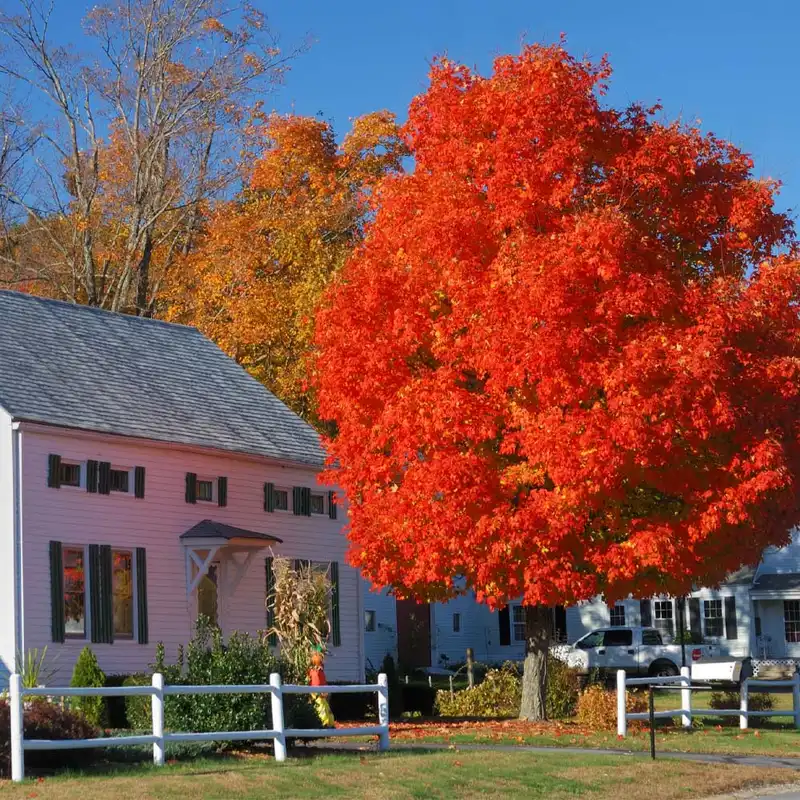
Autumn Blaze® Freeman Maple
Acer x freemanii 'Jeffersred'
A fast-growing Freeman maple with a dense oval canopy and brilliant red autumn foliage.
- Plant Type
- Shade Trees
- Width
- 30-40 Ft.
- Height
- 40-50 Ft.
- USDA hardiness zone
- 3 - 8
- Sun requirements
- Full Sun, Part Shade
- Design image count
- 1
Design images (1)

Bring your vision to life
The design images above are drag-and-drop ready — place this plant on a photo of your own yard and see it before you plant it.
Create design onlineAbout Autumn Blaze® Freeman Maple
Autumn Blaze® Freeman maple is the trade name for the 'Jeffersred' cultivar, a hybrid between red maple and silver maple. It grows quickly into a dense, broad oval canopy, with deeply lobed green leaves that turn bright red in fall. [Oregon State University](https://landscapeplants.oregonstate.edu/plants/acer-freemanii-autumn-blaze) identifies the cultivar and reports a mature size near 50 feet tall by 40 feet wide; its [historical patent USPP4864](https://patents.google.com/patent/USPP4864P/en) was granted July 6, 1982.
## Landscape use and seasonal interest
This large shade tree suits parks, spacious yards, and street plantings where its mature canopy has room to spread. Spring flowers are sparse and may not appear every year; the lasting fall color is its main seasonal feature. Size estimates vary by source: [SuperTrees Nursery](https://nursery.supertrees.com/products/autumn-blaze%C2%AE-maple) lists 40–60 feet tall and 30 feet or more wide, while [NC State Extension](https://plants.ces.ncsu.edu/plants/acer-x-freemanii/) gives a broader 45–70 by 35–50 feet for Freeman maples.
## Siting
Choose full sun or partial shade and moist, well-drained soil. Freeman maples can grow in clay, loam, or sand; NC State notes that established trees tolerate some drought and can handle heavy clay and occasional wet conditions. Leave enough space for a broad crown and strong roots.
## Maintenance
Water regularly while a young tree establishes, then adjust irrigation to rainfall and soil moisture. Following [University of Maryland Extension's tree pruning guidance](https://extension.umd.edu/resource/pruning-trees-home-landscape), inspect the young crown for narrow forks or competing leaders and correct structural problems early; avoid topping a mature tree.