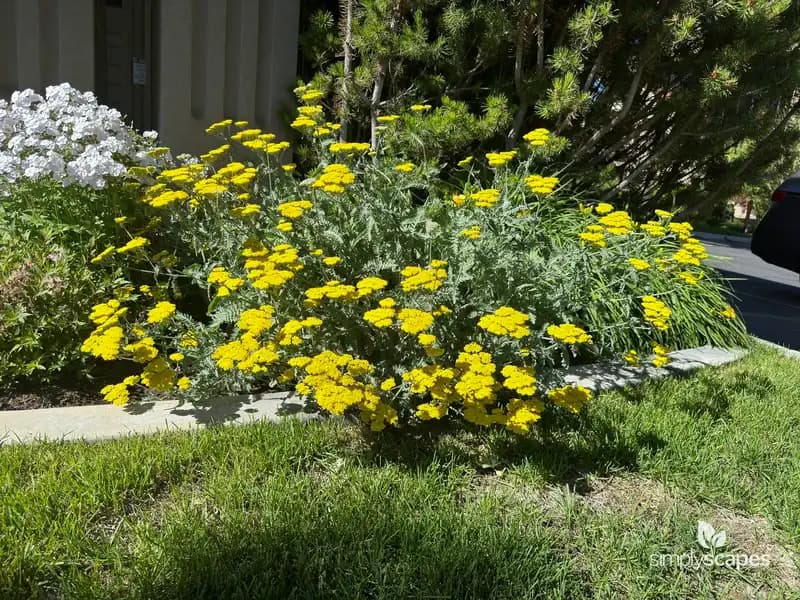
Woolly yarrow
Achillea tomentosa
A low-growing, golden-flowered groundcover with soft, silver-green foliage.
- Plant Type
- Perennials & Annuals
- Width
- 8-18 In.
- Height
- 12-18 In.
- USDA hardiness zone
- 3 - 7
- Sun requirements
- Full Sun
Bring your vision to life
The design images above are drag-and-drop ready — place this plant on a photo of your own yard and see it before you plant it.
Create design onlineAbout Woolly yarrow
Woolly yarrow is a low, spreading perennial with finely divided, wool-covered gray-green leaves and flat clusters of bright yellow flowers. It makes a close-textured groundcover for sunny, well-drained spaces and flowers from late spring into summer.
## Landscape use and appearance
Use it along paths, at the front of a border, between stepping stones, or in rock and gravel gardens. Its mat-forming foliage stays low, while the flower stems rise above the leaves. The leaves are soft and aromatic when crushed. Bees and butterflies visit the flowers.
## Size and siting
North Carolina State Extension reports plants about 6–8 inches tall and 8–18 inches wide; the RHS lists a broader mature range of 0.1–0.5 m in both directions. Plant in full sun and allow room for the mat to spread. The species is listed for USDA Zones 3–7.
## Soil and seasonal interest
Choose sandy, loamy, or shallow rocky soil with good drainage; the species tolerates occasional dryness. Small yellow flower clusters appear from spring into summer, with timing shifting by climate. The fine, gray-green leaves provide a contrasting ground layer around larger flowering perennials.
Sources: [NC State Extension](https://plants.ces.ncsu.edu/plants/achillea-tomentosa/) and [RHS](https://www.rhs.org.uk/plants/318/achillea-tomentosa/details).
## Maintenance
NC State Extension recommends deadheading after flowering to reduce unwanted spread and possibly encourage more blooms; cutting back to basal leaves may tidy the plant and encourage a later flush. It also advises dividing as needed to control size. The RHS says pruning is not required, so treat this as optional management for self-seeding, appearance, or rebloom rather than a fixed pruning schedule.