Matchstick Bromeliad
Aechmea gamosepala
- Plant Type
- House Plants & Tropicals
- Width
- 1–2 ft
- Height
- 1–1.5 ft
- USDA hardiness zone
- 9 - 11
- Sun requirements
- Part Shade
- Water requirements
- Moderate
- Design image count
- 1
Design images (1)

Bring your vision to life
The design images above are drag-and-drop ready — place this plant on a photo of your own yard and see it before you plant it.
Create design onlineAbout Matchstick Bromeliad
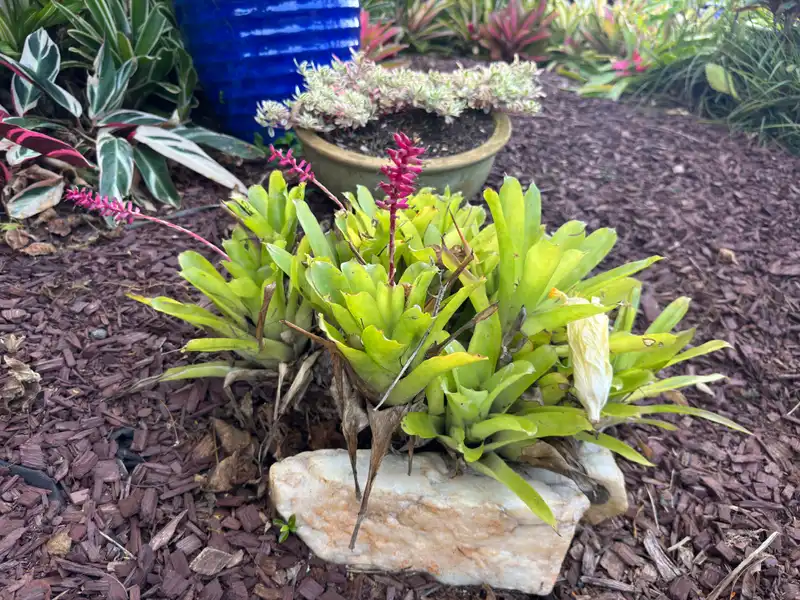
Aechmea gamosepala is an evergreen bromeliad from southeastern and southern Brazil. Its green leaves form a rosette, and mature plants produce a central spike with rose-pink bracts and purple-blue petals. It suits sheltered tropical gardens, containers, or mounted epiphytic displays where its roots can drain freely.
## Growing Conditions
Give it bright partial shade and a porous, fast-draining growing medium. The species is epiphytic, and the National Parks Board’s profile for the closely related var. nivea notes that it can also be mounted on bark or cork; heavy, persistently wet soil risks rot. Water moderately, and avoid stagnant water in the leaf cup.
## Flowering and Form
The flowering rosette produces offsets at its base, which can continue the planting as the original rosette declines after flowering. UF/IFAS describes the exact species at about 1–1.5 ft tall by 1–2 ft wide, with a pink-and-purple match-like inflorescence. The upright pink-and-blue flower spike is the source of its common name. [Kew records](https://powo.science.kew.org/taxon/urn:lsid:ipni.org:names:271696-2/general-information) the species as native to Brazil and growing as an epiphyte. The [UF/IFAS species table](https://ask.ifas.ufl.edu/publication/FP014) supports its size and pink-and-purple match-like inflorescence; the detailed care notes here draw on the Singapore [National Parks Board profile](https://www.nparks.gov.sg/florafaunaweb/flora/6/5/6567) for A. gamosepala var. nivea.
## Maintenance
Remove spent or damaged foliage as needed and separate offsets only when they are large enough to establish independently. Keep the growing medium open and free draining; no recurring pruning schedule is indicated by the cited care source.