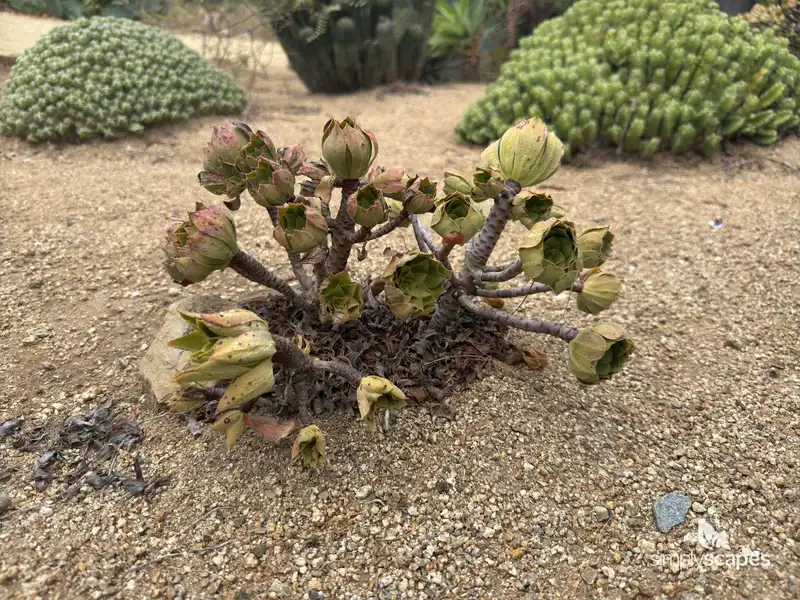
Tree Aeonium
Aeonium arboreum
A striking architectural succulent with vibrant green rosettes.
- Plant Type
- Succulents
- Width
- 3–5 ft
- Height
- 3–5 ft
- USDA hardiness zone
- 9 - 11
- Sun requirements
- Full Sun, Part Shade
- Water requirements
- Moderate
- Design image count
- 18
Design images (18)


Bring your vision to life
The design images above are drag-and-drop ready — place this plant on a photo of your own yard and see it before you plant it.
Create design onlineAbout Tree Aeonium
Tree aeonium (Aeonium arboreum) is an evergreen succulent subshrub with woody stems ending in fleshy, bright green rosettes. It adds a sculptural outline to dry-climate beds and containers; mature plants produce large clusters of small yellow flowers, generally in winter or spring depending on conditions.
## Landscape Use
Use it as a specimen accent, in a mass planting, or as a low hedge in a mild, frost-free setting. Its rosettes and branching stems provide form and texture among lower succulents or contrasting foliage. In South Australia, the Botanic Gardens and State Herbarium’s [Plant Selector](https://plantselector.botanicgardens.sa.gov.au/Plants/Details/814) lists it for ornamental mass planting and hedging, while warning that vegetative spread can make it invasive near conservation parks and coastal reserves; that warning is regional, so check local guidance.
## Growing Conditions
The [Royal Horticultural Society](https://www.rhs.org.uk/plants/498/aeonium-arboreum/details) describes a bushy plant 1–1.5 metres tall and wide, with a sheltered, sunny position and sharply drained loam or sand. The South Australian Botanic Gardens profile reports a 1–1.5 metre spread, yellow flowers in winter and spring, and minimal supplementary watering. Give it free-draining soil and water moderately while actively growing; avoid keeping the mix wet, especially during hot-weather dormancy. Protect it from frost or grow it in a movable container where winters are cold.
## Maintenance
The RHS notes that routine pruning is not required. Remove dead lower leaves only when needed for appearance, and avoid overwatering during hot periods when growth slows.