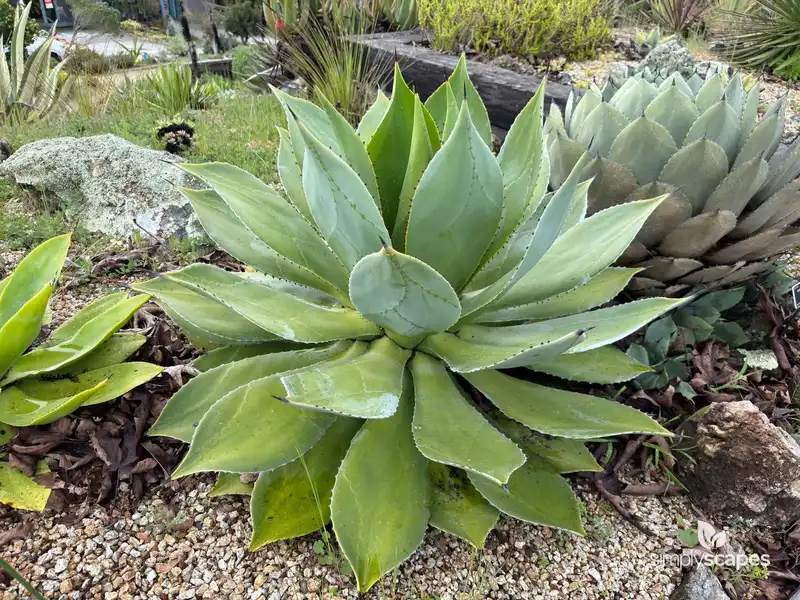
Fox Tail Agave
Agave attenuata
A graceful, spineless succulent with stunning swan-neck blooms.
- Plant Type
- Succulents
- Width
- 6-8 Ft.
- Height
- 4-5 Ft. with 8-10 Ft. flower spike
- USDA hardiness zone
- 9 - 11
- Sun requirements
- Full Sun, Part Shade
- Design image count
- 37
Design images (37)


Bring your vision to life
The design images above are drag-and-drop ready — place this plant on a photo of your own yard and see it before you plant it.
Create design onlineAbout Fox Tail Agave
Agave attenuata, the foxtail or swan’s-neck agave, forms a broad evergreen rosette of soft, pale blue-green leaves on a stout stem. Mature rosettes send up a curved stalk of pale yellow to white flowers, and the unarmed leaves lack sharp terminal spines. Exact-species sources describe each rosette as monocarpic, dying after flowering while basal offsets can persist as a colony; the [UA Campus Arboretum](https://apps.cals.arizona.edu/arboretum/taxon.aspx?id=1163) and [Port St. Lucie Botanical Gardens](https://www.pslbg.org/fox-tail-agave/) describe this cycle.
## Flowering and Propagation
UF/IFAS reports that spineless century plant flowers multiple times a year, but does not say whether this refers to a single rosette or successive offsets. The exact-species profiles describe each flowering rosette as dying after bloom; since offsets form a colony, multiple flowering events may occur across successive rosettes, but same-rosette rebloom is not established. [UF/IFAS](https://gardeningsolutions.ifas.ufl.edu/plants/ornamentals/century-plant/), [UA Campus Arboretum](https://apps.cals.arizona.edu/arboretum/taxon.aspx?id=1163), and [Port St. Lucie Botanical Gardens](https://www.pslbg.org/fox-tail-agave/) report these details.
## Landscape Use and Size
Use this architectural succulent as a specimen in a gravel garden, sheltered courtyard, or large patio container. The Royal Horticultural Society gives a mature range of about 1–1.5 m tall by 1.5–2.5 m wide; UF/IFAS reports 2–3 ft by 3–6 ft for the spineless form. The difference likely reflects growing conditions and age, so allow room for a broad rosette. Its soft foliage lacks the sharp tips common in many agaves.
## Site and Water
Provide full sun to light shade and very free-draining sandy or loamy soil. The species is frost tender in many climates; UF/IFAS places it in USDA zones 9–11. Drought tolerance is strongest once established. [RHS](https://www.rhs.org.uk/plants/670/agave-attenuata/details) and [UF/IFAS](https://gardeningsolutions.ifas.ufl.edu/plants/ornamentals/century-plant/) provide species details; [Kew](https://powo.science.kew.org/taxon/urn:lsid:ipni.org:names:61824-1/general-information) confirms the accepted name and range.
## Maintenance
Water during establishment, then irrigate sparingly and let soil dry between waterings. Keep winter conditions dry and protect from frost; move container plants under cover where freezes occur. Remove dead lower leaves when needed. RHS notes routine pruning is unnecessary.