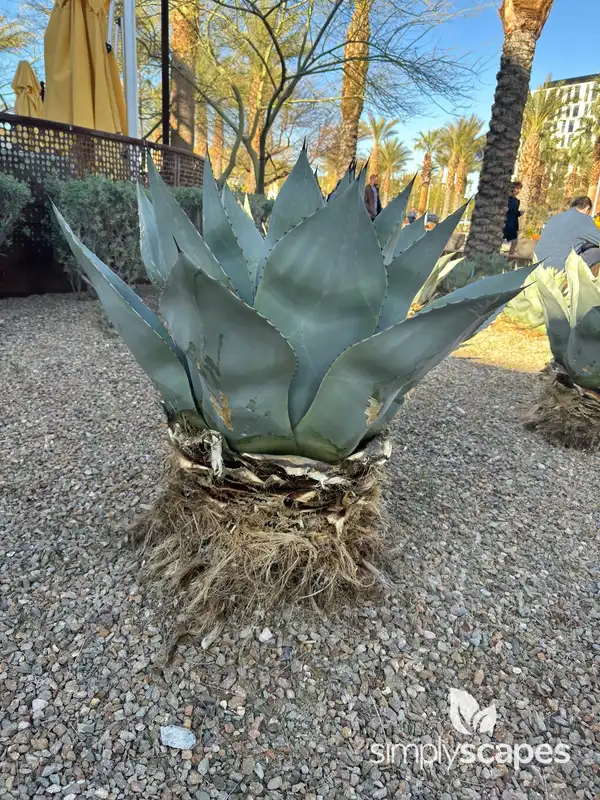
Whale's Tongue Agave
Agave ovatifolia
Stunning silver-blue architectural succulent for modern gardens.
- Plant Type
- Succulents
- Width
- 4–8 Ft.
- Height
- 4-6 Ft.
- USDA hardiness zone
- 7 - 11
- Sun requirements
- Full Sun
- Design image count
- 7
Design images (7)


Bring your vision to life
The design images above are drag-and-drop ready — place this plant on a photo of your own yard and see it before you plant it.
Create design onlineAbout Whale's Tongue Agave
Whale’s tongue agave forms a solitary, symmetrical rosette of broad, cupped blue-gray leaves with small marginal teeth and sharp terminal spines. It makes a strong architectural specimen in a gravel garden or a large container, with the mature plant eventually sending up a dramatic flower stalk. Seed-grown plants vary in leaf shape and size, so allow generous room around the rosette.
## Size and siting
A cultivated plant commonly reaches about 3–4 ft tall and 4–6 ft wide; some references give a broader maximum spread approaching 8 ft. The flowering stalk rises well above the rosette. Plant in full sun and fast-draining soil, such as a raised gravelly bed or slope. It can handle more cold and moisture than many agaves, but waterlogged roots and winter rain can still cause rot. The University of Tennessee Gardens reports drought tolerance and faster growth with supplemental summer water. New plantings benefit from establishment watering and shelter from winter rain while young. The [UT Gardens profile](https://utgardens.tennessee.edu/ut-gardens-march-2020-plant-of-the-month-whales-tongue-agave%E2%80%8B/) and [Ruth Bancroft Garden profile](https://www.ruthbancroftgarden.org/plants/agave-ovatifolia/) describe its blue-gray foliage, size, and life cycle; the [RHS profile](https://www.rhs.org.uk/plants/249854/agave-ovatifolia/details) gives a broader mature spread.
## Maintenance
This species usually does not produce offsets. The rosette flowers once late in life and then dies, so plan for eventual replacement rather than expecting pups. The RHS recommends no routine pruning. Keep a clear path around the sharp leaf tips and wear gloves when handling.