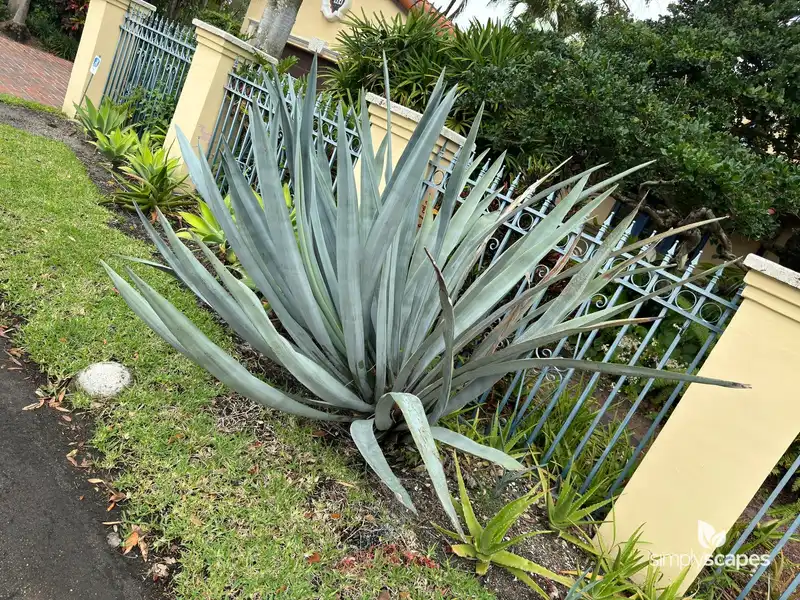
Sisal Agave
Agave sisalana
A majestic succulent known for its architectural form and durable fibers.
- Plant Type
- Succulents
- Width
- 4-6 Ft.
- Height
- 3-4 Ft.
- USDA hardiness zone
- 9 - 11
- Sun requirements
- Full Sun
- Design image count
- 9
Design images (9)


Bring your vision to life
The design images above are drag-and-drop ready — place this plant on a photo of your own yard and see it before you plant it.
Create design onlineAbout Sisal Agave
Sisal agave is an evergreen, tropical succulent with a dense rosette of long, sword-shaped leaves and a short, thick stem. It is grown both as an architectural landscape plant and as the source of commercial sisal fiber, with broad, fibrous leaves giving the plant a substantial presence.
## Form and flowering
Leaves may reach about 5 feet long; they are gray-green when young and become greener with age. A mature plant produces a tall, branching stalk of small yellow-green flowers, then the flowering rosette dies; bulbils may form along the stalk. The [RHS profile](https://www.rhs.org.uk/plants/691/agave-sisalana/details) gives a landscape spread of 5–8 feet, while Kew’s botanical descriptions report rosettes up to 2 metres tall and flower stalks roughly 5–7 metres tall. Allow generous room for the rosette and its eventual flowering structure.
## Site and use
Grow in full sun and sharply drained soil; PROSEA reports sandy loam and other well-drained soils, and notes that the crop is frost-sensitive. This agave suits warm, frost-free gardens, gravel settings, and large containers where its strong leaf form can be viewed at a distance. In central and southern Florida, [UF/IFAS advises managing sisal agave to prevent escape from cultivation](https://assessment.ifas.ufl.edu/assessments/agave-sisalana/).
## Maintenance
Avoid waterlogged soil and protect the leaves from frost. The RHS advises overwintering under glass in cold climates and notes that routine pruning is not required; remove old leaves or the spent flowering stalk only when needed for access or safety.