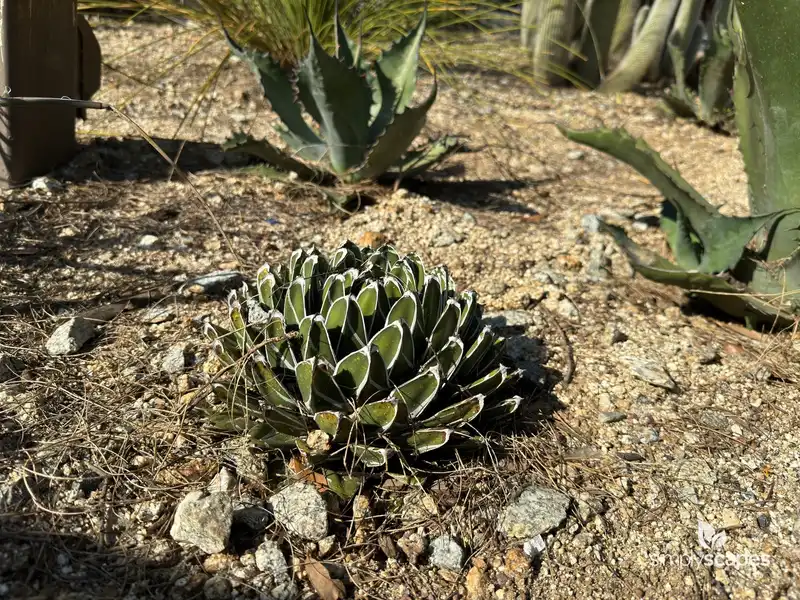
Queen Victoria Agave
Agave victoriae-reginae
A stunning architectural succulent with striking white-patterned leaves.
- Plant Type
- Succulents
- Width
- 12-18 In.
- Height
- 8-12 In.
- USDA hardiness zone
- 7 - 11
- Sun requirements
- Full Sun, Part Shade
- Design image count
- 5
Design images (5)


Bring your vision to life
The design images above are drag-and-drop ready — place this plant on a photo of your own yard and see it before you plant it.
Create design onlineAbout Queen Victoria Agave
Queen Victoria agave is a compact, slow-growing succulent with a dense rosette of stiff, dark green leaves marked by crisp white lines. Its geometric form is most effective as a specimen in a gravel garden or a substantial container, where the patterned leaves can be seen up close.
## Character and placement
The leaves end in sharp points, so keep the plant clear of narrow paths and play areas. The [Royal Horticultural Society](https://www.rhs.org.uk/plants/698/agave-victoriae-reginae/details) describes mature foliage rosettes about 10–50 cm tall and wide, and lists full sun, well-drained loam or sand, and container or patio use. The [Royal Botanic Gardens Victoria HortFlora](https://hortflora.rbg.vic.gov.au/taxon/adab9742-5340-11e7-b82b-005056b0018f) describes small, mostly solitary rosettes roughly 15–35 cm tall and 20–55 cm wide, supporting the compact scale of this selection.
## Flowers and seasons
Mature plants send up a flower spike far taller than the rosette. Flower color reports differ: the RHS describes creamy-white flowers, while the [South Australian Botanic Gardens Plant Selector](https://plantselector.botanicgardens.sa.gov.au/Plants/Details/651) lists red and purple summer flowers. Treat flower color as variable or verify the exact stock when it is in bloom. The evergreen patterned leaves provide the main year-round garden interest.
## Maintenance
Use a fast-draining cactus mix or gritty soil and keep the plant nearly dry during cool winter conditions. Water more freely during active warm-season growth, then let the mix drain thoroughly. The RHS advises no pruning; remove only damaged leaves or offsets if needed, taking care around the sharp tips. For frost-prone climates, grow it in a pot that can be protected under cover.