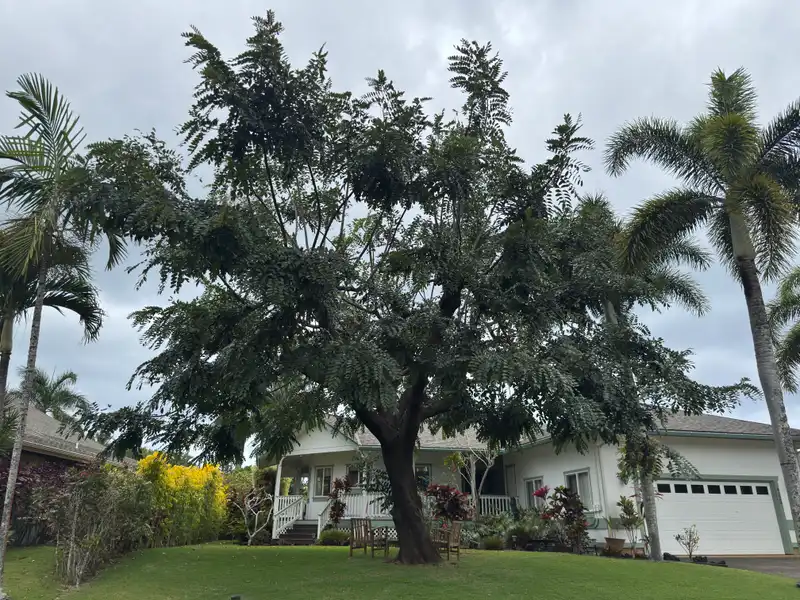
Tree-of-Heaven
Ailanthus altissima
- Plant Type
- Shade Trees
- Width
- 15–30 ft
- Height
- 40–60 ft
- USDA hardiness zone
- 4 - 8
- Sun requirements
- Full Sun, Part Shade
- Water requirements
- Low
- Design image count
- 4
Design images (4)


Bring your vision to life
The design images above are drag-and-drop ready — place this plant on a photo of your own yard and see it before you plant it.
Create design onlineAbout Tree-of-Heaven
Tree-of-heaven is a fast-growing deciduous tree native to China and Taiwan. Its large, pinnate leaves have distinctive gland-tipped teeth near the base of each leaflet; clusters of yellow-green flowers are followed by winged seeds, and roots produce spreading suckers. [Kew’s Plants of the World Online](https://powo.science.kew.org/taxon/urn:lsid:ipni.org:names:813521-1/general-information) accepts the name *Ailanthus altissima* and places it in Simaroubaceae.
## Identification and growth
The leaves can help distinguish it from native look-alikes: [NC State Extension](https://plants.ces.ncsu.edu/plants/ailanthus-altissima/) notes the notched, glandular leaflet bases, dense thickets, and yellow flowers followed by wind- or water-dispersed seeds. [UConn Extension](https://extension.uconn.edu/publication/tree-of-heaven-ailanthus-altissima/) describes flowering in late May through early June and root suckers spreading far from parent trees. NC State reports a mature size of 40–60 feet tall and 15–30 feet wide, USDA zones 4a–8b, rapid growth, and an erect habit. The [USDA Forest Service](https://research.fs.usda.gov/feis/species-reviews/ailalt) reports mature trees reaching 60–70 feet tall with crowns up to 80 feet wide, so actual size can exceed the more compact regional estimate.
## Where it grows
It tolerates a range of soils and light conditions, and [University of Florida IFAS](https://ask.ifas.ufl.edu/publication/ST067) reports high drought tolerance. NC State Extension and UConn Extension describe it as invasive in parts of the United States; dense colonies can displace native plants, and cutting can trigger vigorous root sprouting. Treat it as an identification and management concern rather than a recommended landscape planting, and check local guidance before disturbing established trees.
## Maintenance
Monitor the planting area for seedlings and root suckers. Established stands require repeated monitoring and control, according to [UConn Extension](https://extension.uconn.edu/publication/tree-of-heaven-ailanthus-altissima/); cutting alone can stimulate new shoots, so seek local extension or qualified invasive-plant guidance for a site-specific plan.