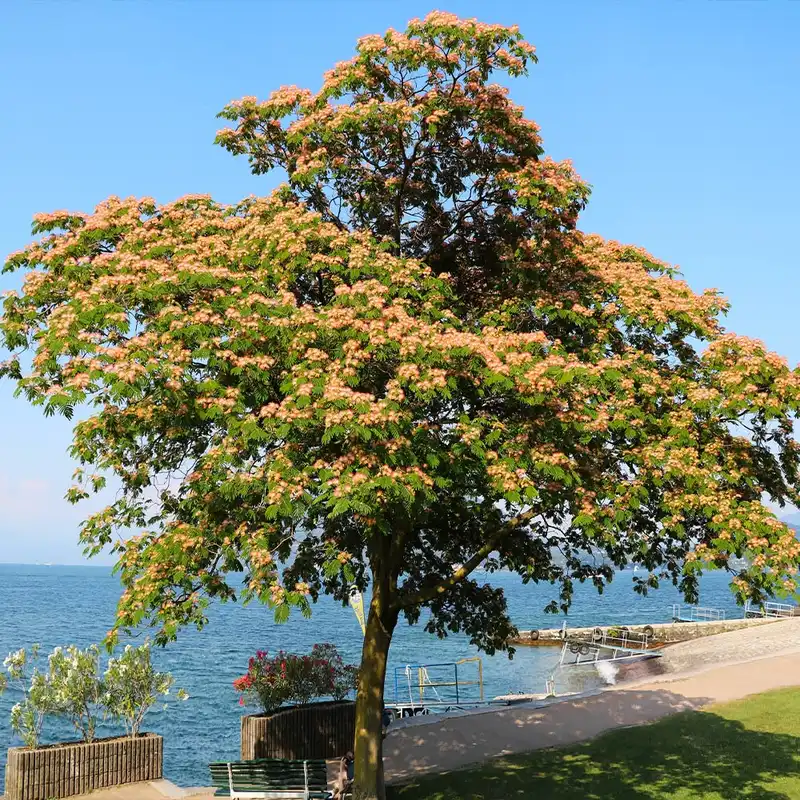
Cold Hardy Mimosa Tree
Albizia julibrissin 'EH Wilson'
Elegant, cold-hardy mimosa with stunning pink flowers and tropical fern-like leaves.
- Plant Type
- Flowering Trees
- Width
- 30 ft
- Height
- 25 ft
- USDA hardiness zone
- 5 - 10
- Sun requirements
- Full Sun, Part Shade
- Design image count
- 2
Design images (2)


Bring your vision to life
The design images above are drag-and-drop ready — place this plant on a photo of your own yard and see it before you plant it.
Create design onlineAbout Cold Hardy Mimosa Tree
Albizia julibrissin ‘EH Wilson’ is a deciduous silk tree selected for greater cold hardiness than the usual mimosa, with an open, umbrella-shaped crown and fragrant pink-and-white, threadlike flower clusters. It is a broad, fast-growing specimen for a sunny, well-drained site where its mature spread and regional reseeding potential can be managed.
## Form and flowering
The cultivar is sold as EH Wilson or Cold Hardy Mimosa. [Acorn Farms’ cultivar listing](https://www.acornfarms.com/upload/0047) describes a tree about 25 feet tall and 30 feet wide, blooming from July into September; [Cornell’s Woody Plants Database](https://woodyplants.cals.cornell.edu/plant/318) identifies ‘EH Wilson’ as a cold-hardy selection and describes the species’ broad, flat-topped crown and fragrant pink flowers. Actual size and hardiness depend on climate and growing conditions. The finely divided leaves close at night and drop in autumn.
## Siting
Use full sun for strongest flowering, though partial shade is tolerated. Choose soil that drains well; the cultivar listing describes loamy or sandy soil kept evenly moist. NC State Extension notes that common mimosa readily escapes cultivation and is invasive in parts of the southeastern United States, so check local guidance before planting and prevent unwanted seedlings. The cultivar is not documented as sterile.
## Maintenance
Allow room for a wide, low-branched crown and inspect young trees after storms. Remove damaged or crossing branches as needed, and collect seedpods or seedlings where spread is a concern. Water during establishment and extended dry spells; avoid a persistently saturated root zone.