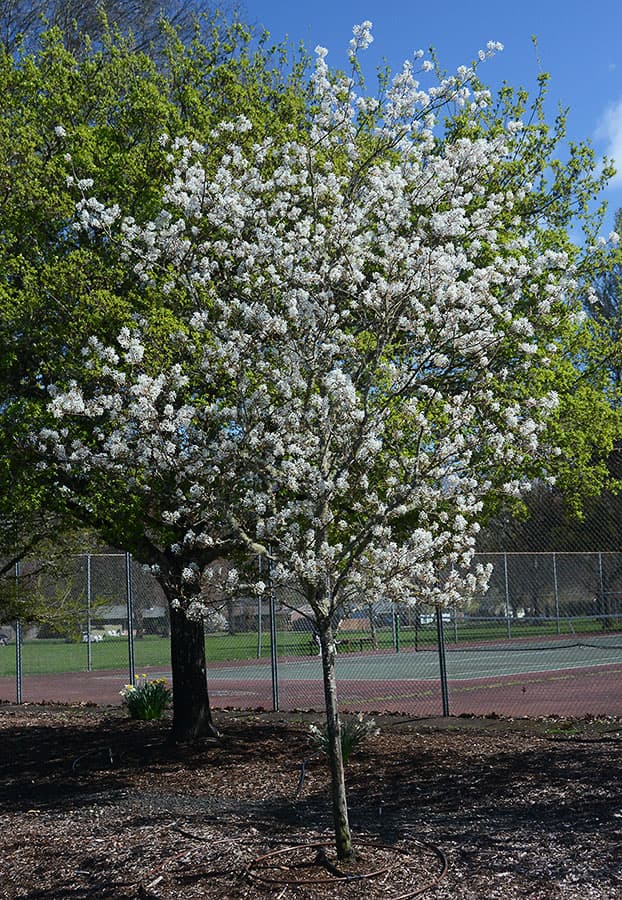
Autumn Brilliance Serviceberry Tree
Amelanchier x grandiflora 'Autumn Brilliance'
Spectacular white blooms and brilliant red autumn color for any landscape.
- Plant Type
- Flowering Trees
- Width
- 15-20 Ft.
- Height
- 20-25 Ft.
- USDA hardiness zone
- 4 - 9
- Sun requirements
- Full Sun, Part Shade
- Water requirements
- Moderate
- Design image count
- 5
Design images (5)


Bring your vision to life
The design images above are drag-and-drop ready — place this plant on a photo of your own yard and see it before you plant it.
Create design onlineAbout Autumn Brilliance Serviceberry Tree
‘Autumn Brilliance’ is a vigorous apple serviceberry selected for abundant white flowers, edible dark early-summer fruit and orange-red fall leaves. Its upright, often multi-stemmed form works as a small specimen tree or a broad screen where there is room for its crown.
## Landscape use and seasonal interest
Oregon State University describes this selection as *Amelanchier × grandiflora*, introduced by Willet Wandell in 1986, with abundant white flowers and edible sweet fruit that matures dark purple-black in early summer. The university records US Plant Patent PP 5,717; that historical reference does not establish current legal status. See the [OSU cultivar profile](https://landscapeplants.oregonstate.edu/plants/amelanchier-grandiflora-autumn-brilliance). Its spring bloom, summer berries and orange-red fall color provide three distinct seasons of interest.
## Size and siting
OSU reports a mature range of roughly 15–25 feet tall with a similar spread; Minnesota Extension lists 25 by 15 feet. These source ranges differ, so allow a broad crown and retain the current catalog dimensions as a defensible estimate. Grow in full sun to part shade in medium-moist, well-drained soil. It tolerates a range of soil types and has some resistance to leaf spot, though resistance is not immunity. The [University of Minnesota serviceberry guide](https://extension.umn.edu/garden-and-home/yard-and-garden/lawns-and-landscapes-in-minnesota/trees-and-shrubs/serviceberry) covers landscape placement and cultivar sizing.
## Maintenance
Water while establishing and during prolonged dry spells. Remove damaged or crossing branches after flowering, or selectively train one trunk if a tree form is preferred. Clean up fallen fruit near paving when needed; monitor foliage for leaf spot and maintain airflow rather than relying on resistance alone.
## Pacific Northwest — PNW 590 (2023): Serviceberry or juneberry
The [trees-9 profile](https://extension.oregonstate.edu/gallery/fire-resistant-plant-profiles-trees) prints Amelanchier species. Amelanchier 'Autumn Brilliance': Explicit source-body example, retaining named selection, taxonomic rank and trade-code scope. This is not an independent test or a transfer of the main profile's dimensions to the selection.
Source care: Low water use; Full sun to partial shade. Keep tree-form Autumn Brilliance, Princess Diana, Robin Hill and Spring Flurry/JFS-Arb and the A. laevis alternative distinct from the shrub/native form account. A shared genus record does not make both sets of dimensions universal.
Profile reference data: Height: 20–25 feet; Spread: 10–15 feet; USDA hardiness zones: 4–8; Fall color: red–orange. These are profile-level source values, not independent measurements of each named example or edits to this record's scalar fields. Native-form availability, wildlife use and general deer-resistance statements are not automatic attributes of every selection.
The [2023 guide](https://extension.oregonstate.edu/catalog/pnw-590-fire-resistant-plants-home-landscapes) requires maintained, healthy, adequately watered plants and removal of dead/spent material. Keep the first 5 feet from the home free of plants. In the 5–30-foot zone separate planting groups by at least 10 feet, farther on slopes; avoid continuous rows and ladder fuels and keep tree branches at least 15 feet from the home. This is a regional source association, not a numerical flammability score or a claim of fireproofness. Older PNW editions and other regional ratings remain separate.