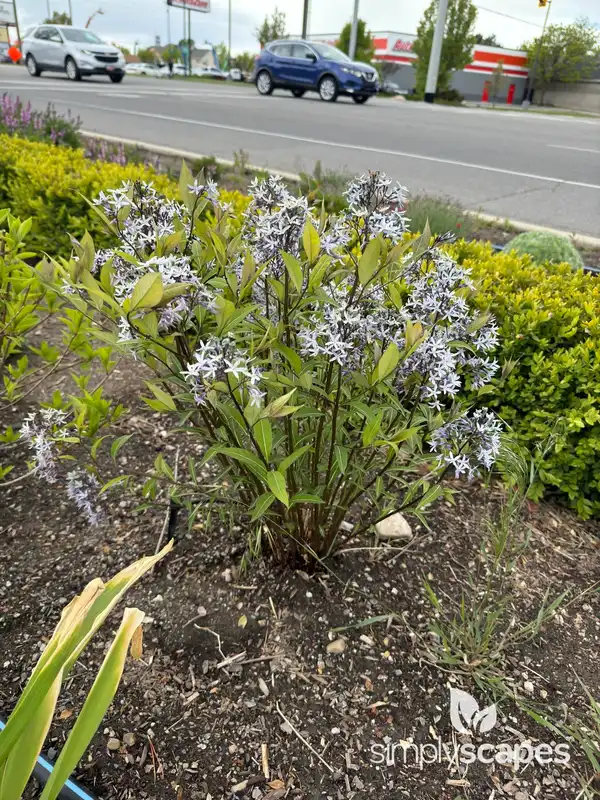
Bluestar (Amsonia)
Amsonia
Elegant blue stars and golden fall foliage for effortless beauty.
- Plant Type
- Perennials & Annuals
- Width
- 24-36 In.
- Height
- 24-36 In.
- USDA hardiness zone
- 4 - 9
- Sun requirements
- Full Sun, Part Shade
Bring your vision to life
The design images above are drag-and-drop ready — place this plant on a photo of your own yard and see it before you plant it.
Create design onlineAbout Bluestar (Amsonia)
Bluestars (*Amsonia*) are clump-forming herbaceous perennials grown for clusters of small, star-shaped blue flowers and attractive foliage. Most flower in spring or early summer; some species add yellow-to-gold autumn color. Species differ considerably in mature size, leaf texture, and soil moisture needs.
## Landscape use and seasonal interest
Amsonias suit mixed perennial borders, woodland edges, and native or wildflower plantings. Their foliage ranges from narrow and willow-like to fine and threadlike, giving plantings a soft texture after flowering. The genus includes compact ground-cover forms and larger plants approaching shrub size, so confirm the species or cultivar before setting spacing. The flowers are held in terminal clusters and make a blue spring display; fall color is especially strong in some species, rather than uniform across the genus. See [Iowa State University Extension](https://yardandgarden.extension.iastate.edu/how-to/bonkers-bluestars) and the [Chicago Botanic Garden’s Amsonia overview](https://www.chicagobotanic.org/plant-information/plant-finder/amsonia-tabernaemontana-blue-star).
## Siting and care
Many bluestars grow in full sun to partial shade and prefer fertile, well-drained soil. Moisture needs differ among species: *A. tabernaemontana* favors moister conditions, while *A. ciliata* and *A. hubrichtii* are better suited to drier sites. Once established, some species tolerate dry soil. Avoid applying one species’ mature dimensions or hardiness range to the whole genus; select a named species for local climate and site conditions. Dense root systems can make established plants difficult to divide or move.
## Maintenance
Allow the clump to develop naturally. Plants in shade may become loose or floppy; where needed, cut back after flowering to encourage a more compact habit. Water during establishment, then follow the chosen species’ moisture needs. Avoid moving mature clumps unless necessary.