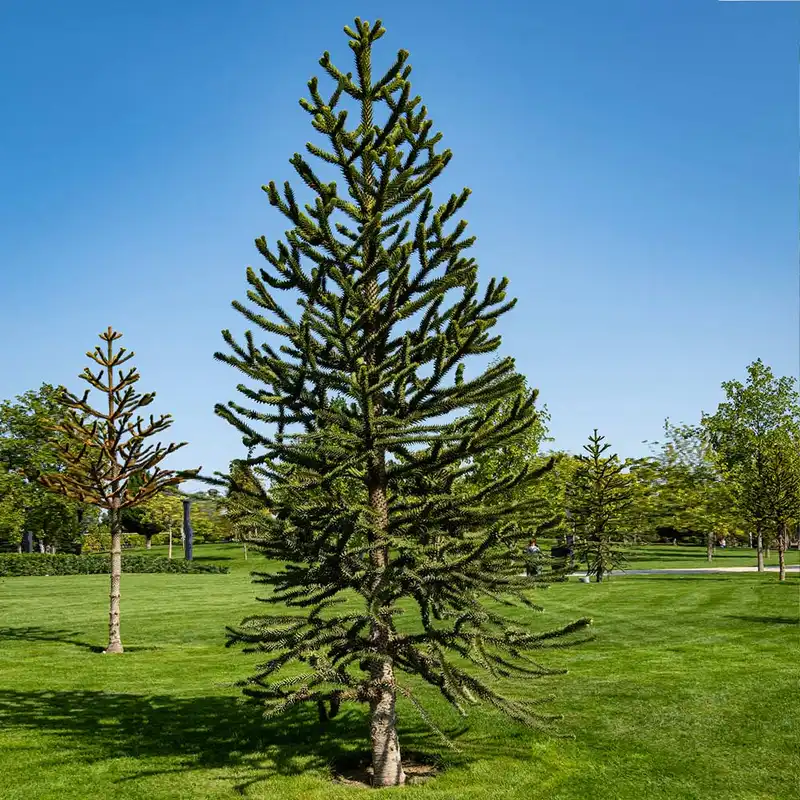
Monkey Puzzle Tree
Araucaria araucana
A prehistoric living fossil with iconic, reptilian branches for dramatic landscapes.
- Plant Type
- Conifer Trees
- Width
- 20-30 Ft.
- Height
- 60-70 Ft.
- USDA hardiness zone
- 6 - 10
- Sun requirements
- Full Sun
- Water requirements
- Medium
- Design image count
- 1
Design images (1)

Bring your vision to life
The design images above are drag-and-drop ready — place this plant on a photo of your own yard and see it before you plant it.
Create design onlineAbout Monkey Puzzle Tree
Monkey Puzzle Tree (*Araucaria araucana*) is a slow-growing evergreen conifer native to the Andes of southern Chile and western Argentina, with symmetrical branches and stiff, sharply pointed leaves that create an unmistakable architectural outline. Young trees are conical, while mature trees develop a broad crown above a tall trunk and may become a very large specimen, so choose a permanent site with generous room ([NC State Extension](https://plants.ces.ncsu.edu/plants/araucaria-araucana/common-name/monkey-puzzle-tree/), [Trees and Shrubs Online](https://www.treesandshrubsonline.org/articles/araucaria/araucaria-araucana/)).
## Landscape Use
Use as a focal specimen in cool-temperate gardens with space for its mature canopy and sharp foliage. NC State reports a native height around 130 ft, while garden sources commonly report smaller cultivated heights; the live 20 m value is therefore retained as a plausible cultivated estimate. The species is distinct from Paraná pine (*A. angustifolia*), despite superficial similarity in young plants.
## Growing Conditions
Provide full sun and freely drained soil. NC State describes frequent watering as beneficial and notes good performance in maritime climates with mild, cool conditions; avoid persistent waterlogging and prolonged drought while the tree establishes. Hardiness figures differ among references and climate contexts, so the catalog’s broad zone range is preserved pending a better location-specific basis. This species is listed as Endangered and is included in CITES Appendix I; acquire legally sourced nursery plants rather than collecting from wild populations.
## Maintenance
Water regularly through the first growing season and during extended dry periods once established. Do not plan routine shaping or severe pruning; retain its natural branching structure. Protect young trees from harsh winter exposure and strong drying winds where needed. Allow clear space around mature branches and avoid locating it beside narrow walkways because the leaves are rigid and sharply pointed.