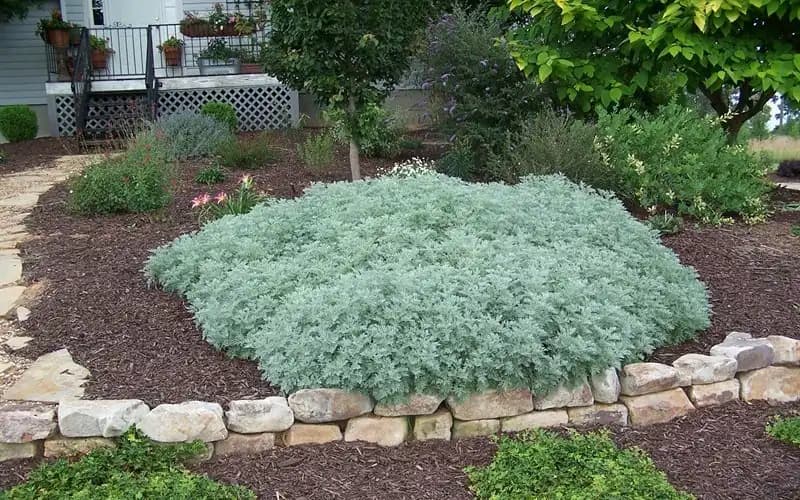
Powis Castle Artemisia
Artemisia x 'Powis Castle'
A stunning, feathery silver subshrub for sun-drenched gardens.
- Plant Type
- Perennials & Annuals
- Width
- 36 In.
- Height
- 30 In.
- USDA hardiness zone
- 4 - 9
- Sun requirements
- Full Sun
- Design image count
- 5
Design images (5)


Bring your vision to life
The design images above are drag-and-drop ready — place this plant on a photo of your own yard and see it before you plant it.
Create design onlineAbout Powis Castle Artemisia
‘Powis Castle’ is a low, rounded Artemisia valued for finely divided, aromatic silver-gray leaves. Small, inconspicuous yellow-toned flower heads appear in late summer, while the foliage supplies most of its ornamental effect.
## Landscape use
Place it in a sunny gravel garden, rock garden, or informal border where the finely textured foliage contrasts with broader leaves and stronger flower colors. The Royal Horticultural Society accepts Artemisia ‘Powis Castle’ and lists Artemisia arborescens ‘Powis Castle’ among its synonyms. [Royal Horticultural Society](https://www.rhs.org.uk/plants/92327/artemisia-powis-castle/details)
## Siting and seasonal interest
Grow it in full sun and well-drained soil. The RHS describes finely divided silver leaves and insignificant dull yellow flower heads in late summer; it also recommends cutting back to new shoots in mid to late spring. [RHS plant profile](https://www.rhs.org.uk/plants/92327/artemisia-powis-castle/details) Allow air and drainage around the crown, especially in wet-winter areas.
## Mature size
Expect a compact shrub around 1–3 feet tall and 2–3 feet wide, with final size influenced by climate and pruning. The RHS profile gives a broader mature range of 0.1–0.5 m tall and 0.5–1 m wide. [RHS plant profile](https://www.rhs.org.uk/plants/92327/artemisia-powis-castle/details)
## Maintenance
In mid to late spring, cut back to the lowest new shoots near the base. Avoid cutting into old woody stems unless undertaking rejuvenation, since the plant may die back from hard pruning. Good drainage and restrained feeding help maintain a compact form.