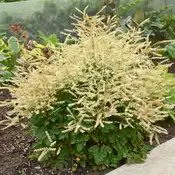
Chantilly Lace Goatsbeard
Aruncus hybrid 'Chantilly Lace'
Airy elegance for shade with lacy cream flowers and fern-like foliage.
- Plant Type
- Perennials & Annuals
- Width
- 3.3-4 Ft.
- Height
- 30-32 In.
- USDA hardiness zone
- 3 - 7
- Sun requirements
- Full Sun, Part Shade
- Plant developer
- Proven Winners
- Design image count
- 1
Design images (1)

Bring your vision to life
The design images above are drag-and-drop ready — place this plant on a photo of your own yard and see it before you plant it.
Create design onlineAbout Chantilly Lace Goatsbeard
‘Chantilly Lace’ is a compact Aruncus hybrid with finely divided green foliage and airy sprays of creamy flowers. Proven Winners lists it at 30–32 inches tall and 40–48 inches wide, with flowering from spring into summer; the cultivar is suited to a shaded or partly shaded perennial border.
## Landscape Use
Use it as a medium-height clumping perennial in woodland edges, mixed borders, or large containers. The breeder identifies the plant as an Aruncus hybrid, and the patent traces its parentage through ‘Misty Lace’ and an unnamed selection; it should not be represented as a pure A. aethusifolius cultivar. The patent grant is USPP 30,740, issued July 23, 2019. [Proven Winners](https://www.provenwinners.com/p/10885) provides current plant size and garden guidance; the [patent description](https://patents.justia.com/patent/PP30740) documents its identity and distinctive traits.
## Seasonal Interest
The finely textured, medium-green foliage forms a dense mound beneath the flower scapes. Cream-colored blooms are most noticeable in late spring and early summer, with timing shifting by climate. The cultivar’s flower display and fern-like leaves offer contrast with broader-leaved shade plants.
## Siting
Provide moist, humus-rich soil. Proven Winners says it can grow in sun or shade, with more shade preferred in southern climates and adequate moisture needed in northern full-sun sites. Its spread reaches roughly 40–48 inches, so allow space around the clump. The brand also describes it as more drought tolerant than Astilbe; that comparison does not establish a drought-free planting requirement.
## Maintenance
Keep soil from drying for prolonged periods, especially in sunny sites. No cultivar-specific recurring pruning requirement was established by the sources reviewed; remove damaged foliage as needed and retain the natural mound.