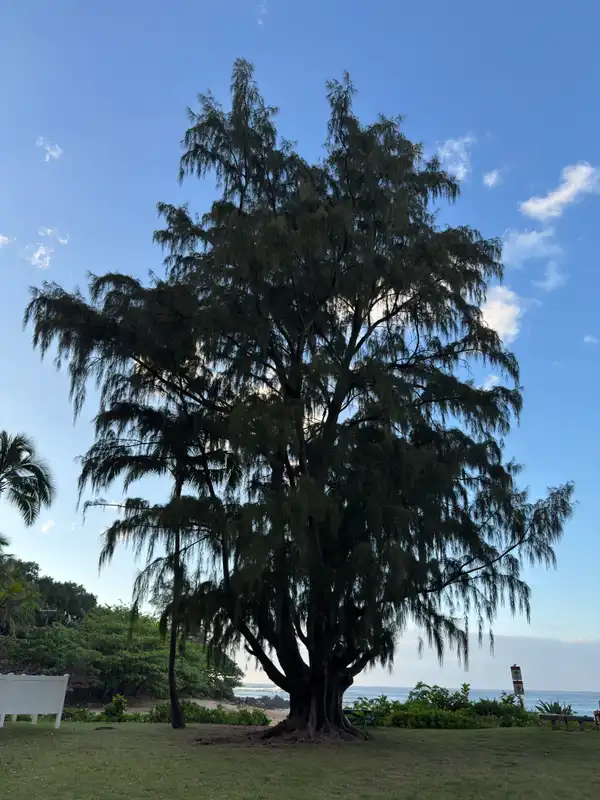
Australian Pine
Casuarina equisetifolia
- Plant Type
- Shade Trees
- Width
- 30–40 ft
- Height
- 70–90 ft
- USDA hardiness zone
- 9 - 11
- Sun requirements
- Full Sun
- Water requirements
- Moderate
- Design image count
- 3
Design images (3)


Bring your vision to life
The design images above are drag-and-drop ready — place this plant on a photo of your own yard and see it before you plant it.
Create design onlineAbout Australian Pine
Casuarina equisetifolia is an evergreen coastal tree with gray-green, needle-like branchlets and small cone-shaped fruiting heads. It has been widely planted for shelter and shade, but it spreads readily in some regions and can damage coastal habitats. [UF/IFAS Extension](https://ask.ifas.ufl.edu/publication/FR366) describes the tree and its Florida restrictions; the [Florida Department of Agriculture](https://www.fdacs.gov/Agriculture-Industry/Pests-and-Diseases/Plant-Pests-and-Diseases/Noxious-Weeds/Casuarina-spp.-Australian-Pines) documents its spread and ecological impacts.
## Landscape use
This is a very large tree with an open crown and extensive, shallow roots. It has historically been planted in coastal windbreaks and screens, where it tolerates salt spray and sandy soils. In Florida, it is classified as an invasive, prohibited plant; do not plant or transport it there. Suitability and restrictions vary by location.
## Foliage and flowers
The apparent needles are segmented green branchlets, with tiny scale-like leaves in whorls. Male and female flowers are inconspicuous, and the female flowers develop into woody cone-like heads containing small winged seeds. Numerous seeds can be dispersed by wind.
## Siting and soil
It grows in full sun and tolerates saline, sandy, and low-fertility soils. Its roots can spread broadly near the surface, and shallow rooting makes large trees vulnerable to windthrow. Keep mature trees well away from buildings and areas where roots or falling limbs create hazards.
## Maintenance
This species grows rapidly and can become very large. Remove hazardous trees only with a qualified arborist, and check local rules before moving or planting it. Do not treat it as a true pine; its needle-like structures are modified branchlets.