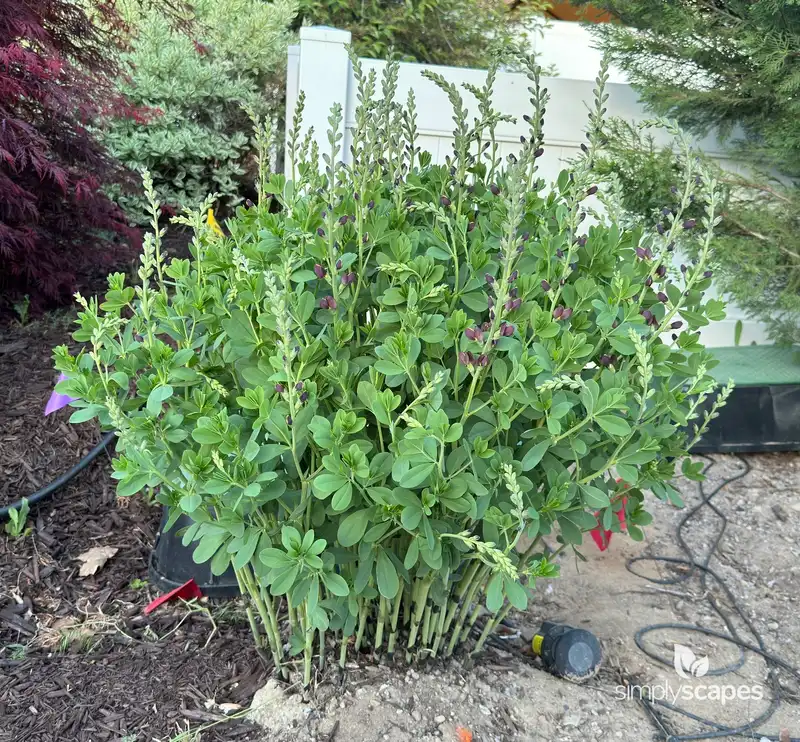
False Indigo
Baptisia australis
Stunning indigo-blue spikes and clover-like foliage for a hardy, low-maintenance garden.
- Plant Type
- Perennials & Annuals
- Width
- 3-4 Ft.
- Height
- 3-4 Ft.
- USDA hardiness zone
- 3 - 9
- Sun requirements
- Full Sun, Part Shade
- Design image count
- 1
Design images (1)

Bring your vision to life
The design images above are drag-and-drop ready — place this plant on a photo of your own yard and see it before you plant it.
Create design onlineAbout False Indigo
Blue false indigo (Baptisia australis) is a long-lived North American perennial that forms a broad clump of blue-green, three-part leaves and upright spikes of indigo-blue, pea-shaped flowers. The flowers appear in late spring and sometimes early summer, followed by black, inflated seed pods that can remain ornamental after bloom.
## Landscape use
Use this native species in sunny borders, meadow plantings, or pollinator gardens where its mature spread can develop undisturbed. North Carolina State Extension gives a typical height of 3–4 feet and spread of 2–4 feet. The deep taproot makes established plants resilient in dry periods but difficult to transplant, so select a permanent location before planting.
## Siting and growth
Full sun generally gives the best flowering, while part shade is tolerated. Choose average, well-drained soil; Baptisia australis can handle a range of soil conditions, but prolonged waterlogging is unsuitable. Water new plants while they establish. Afterward, supplemental irrigation is mainly useful during extended drought. Flowers attract bees, butterflies, and other insects, and the species is a host plant for several butterfly larvae.
The [N.C. Extension Plant Toolbox](https://plants.ces.ncsu.edu/plants/baptisia-australis/common-name/blue-false-indigo/) documents the species identity, size, habitat, and care; [N.C. State Extension Homegrown](https://homegrown.extension.ncsu.edu/2019/03/14/how-to-grow-baptisia-in-your-garden/) gives genus-level context on drought tolerance and low maintenance. This is the straight species, not one of the many named Baptisia hybrids.
## Maintenance
Leave seed pods if their dark shape is wanted, or remove them after flowering to keep the clump tidy. Cut back frost-damaged stems in late winter or early spring. Avoid dividing or relocating established plants because the deep root is easily disturbed.