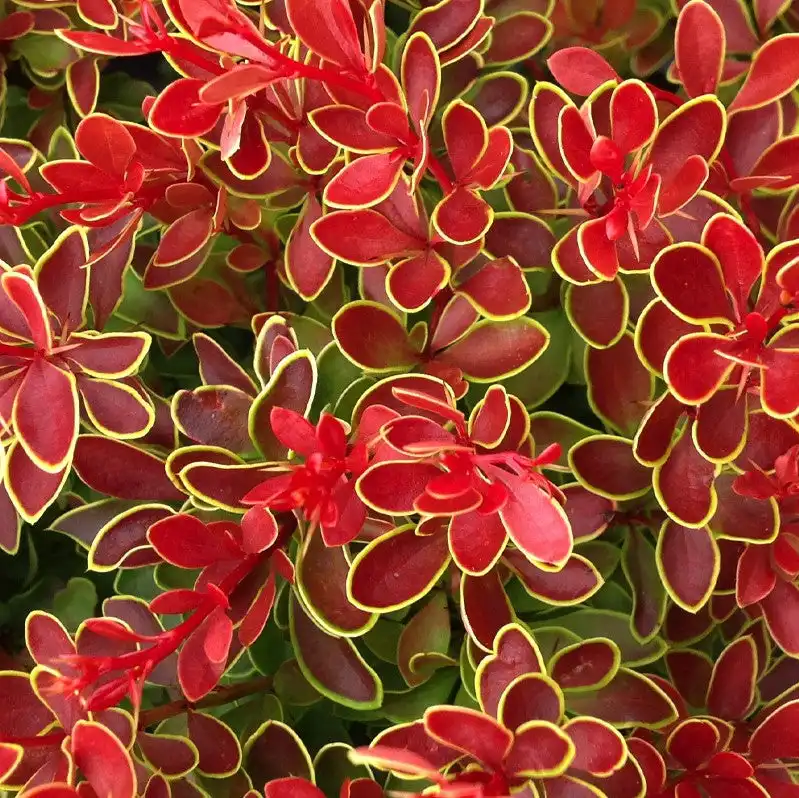
Admiration Barberry
Berberis thunbergii 'Admiration'
Vibrant coral-red foliage with golden edges for stunning small-garden color.
- Plant Type
- Shrubs & Roses
- Width
- 12-24 In.
- Height
- 12-24 In.
- USDA hardiness zone
- 4 - 8
- Sun requirements
- Full Sun, Part Shade
- Design image count
- 1
Design images (1)

Bring your vision to life
The design images above are drag-and-drop ready — place this plant on a photo of your own yard and see it before you plant it.
Create design onlineAbout Admiration Barberry
‘Admiration’ is a compact Japanese barberry valued for small orange-red leaves edged with a narrow golden margin. Its rounded outline stays colorful through summer, then the foliage deepens toward scarlet in autumn. The [RHS cultivar profile](https://www.rhs.org.uk/plants/226438/berberis-thunbergii-f-atropurpurea-admiration/details) describes spring flowers as pale yellow with red tones, followed by crimson berries; [Briggs Nursery](https://www.briggsnursery.com/plant/berberis-thunbergii-admiration-pp16921/) identifies the cultivar as PP 16,921.
## Landscape Use
Use this dwarf shrub as a low accent, in a small border, or in a mixed container. Its foliage gives a defined color patch among green or gold-leaved plants. Its short spines make it unsuitable beside narrow paths where people brush past.
## Seasonal Interest
The strongest display comes from the variegated foliage: orange-red leaves carry a thin yellow edge in summer and become brighter red in fall. Small spring flowers may be followed by red berries.
## Mature Size
The RHS gives a height of about 60–75 cm, while Briggs lists approximately 2 feet by 2 feet. The current metric dimensions remain plausible for this compact shrub.
## Siting and Soil
Grow in full sun for the strongest foliage color; it tolerates partial shade. Choose well-drained soil. Briggs lists zone 4, while the current catalog lists zones 4–8; the broader range is retained because cultivar estimates vary among references.
## Maintenance
Water regularly while establishing, then during extended dry periods. Briggs reports established-plant drought tolerance. Pruning is usually unnecessary for the naturally compact outline; wear gloves when handling thorny stems.