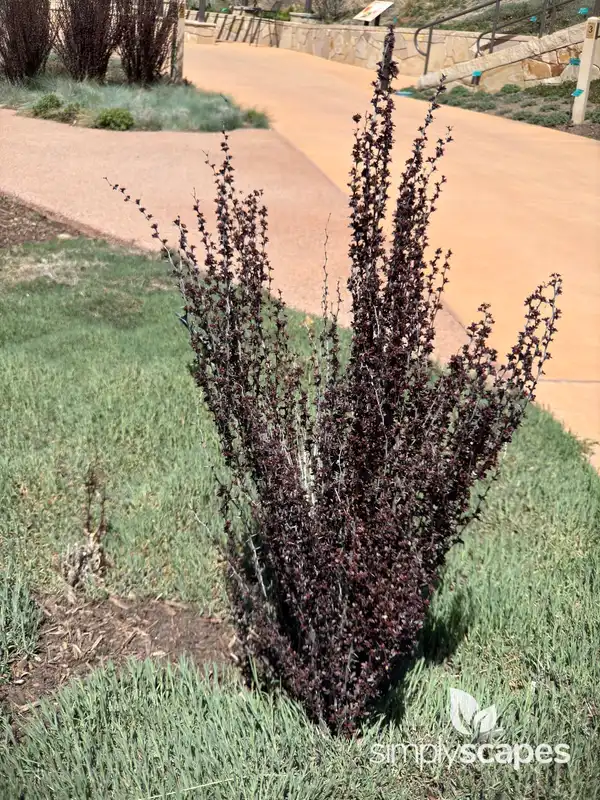
Barberry Bush
Berberis thunbergii
A tough, colorful shrub with brilliant fall foliage and winter berries.
- Plant Type
- Shrubs & Roses
- Width
- 4-7 Ft.
- Height
- 3-6 Ft.
- USDA hardiness zone
- 4 - 8
- Sun requirements
- Full Sun, Part Shade
- Design image count
- 29
Design images (29)


Bring your vision to life
The design images above are drag-and-drop ready — place this plant on a photo of your own yard and see it before you plant it.
Create design onlineAbout Barberry Bush
Japanese barberry (Berberis thunbergii) is a dense deciduous shrub with small leaves, thorny stems, yellow spring flowers and red berries, as described in the [North Carolina Extension profile](https://plants.ces.ncsu.edu/plants/berberis-thunbergii/). Its green foliage turns bright red, orange or yellow in autumn. The species is invasive in parts of North America, so check local restrictions and consider a non-invasive alternative where it is a problem, as discussed in the [Forest Service review](https://research.fs.usda.gov/feis/species-reviews/berthu).
## Landscape use
The shrub has traditionally been used for hedges and barriers, but its spread by seed and root suckers makes it a poor choice in regions where it is invasive. North Carolina Extension specifically identifies Japanese barberry as invasive in that state; the U.S. Forest Service documents broader invasion in parts of North America. Avoid planting where local guidance prohibits it.
## Size and siting
North Carolina Extension gives typical mature dimensions of 3–6 feet tall and 4–7 feet wide, with USDA hardiness zones 4a–8b. It grows in full sun to partial shade and tolerates a range of soil conditions, though good drainage is useful.
## Maintenance
Water during establishment and prune only when needed to maintain the intended form. Wear gloves when handling the thorny branches. Red berries can persist into winter and are spread by birds, which is one reason this species can escape planted areas. Where a similar ornamental shrub is desired, choose a locally recommended sterile cultivar or a native alternative.