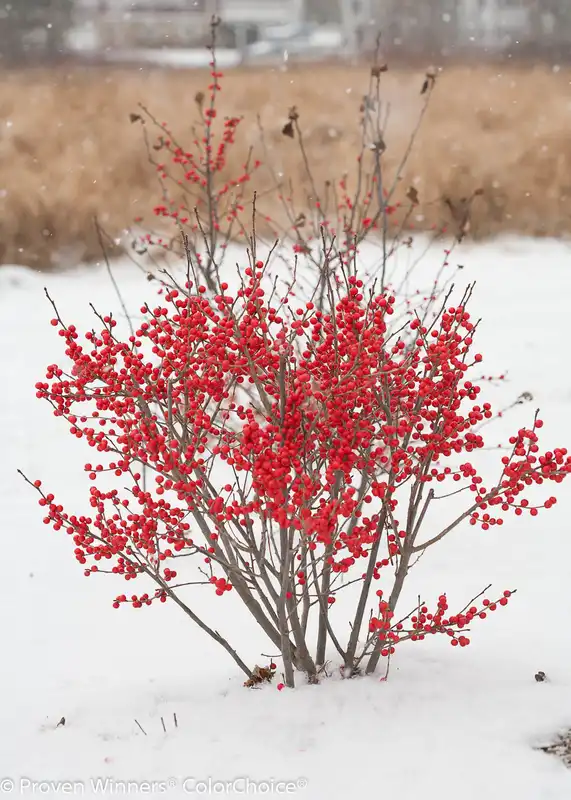
Berry Poppins® Winterberry
Ilex verticillata 'FarrowBPop' USPP25835, Can PP5286
A compact dwarf winterberry with a heavy crop of brilliant red berries for winter color.
- Plant Type
- Shrubs & Roses
- Width
- 3-4 Ft.
- Height
- 3-4 Ft.
- USDA hardiness zone
- 3 - 9
- Sun requirements
- Full Sun, Part Shade
- Plant developer
- Proven Winners
- Design image count
- 3
Design images (3)
-10145-E.webp&w=3840&q=75)
.webp&w=3840&q=75)
-10145-C---PW.webp&w=3840&q=75)
Bring your vision to life
The design images above are drag-and-drop ready — place this plant on a photo of your own yard and see it before you plant it.
Create design onlineAbout Berry Poppins® Winterberry
Berry Poppins® Winterberry is the named selection *Ilex verticillata* 'FarrowBPop', a compact, upright, deciduous holly that reaches about 3–4 feet tall and wide. Small greenish-white flowers appear in late spring or early summer, followed by bright red berries that persist into winter and attract birds ([University of Minnesota UFOR Nursery & Lab](https://trees.umn.edu/berry-poppins%C2%AE-winterberry-ilex-verticillata-farrowbpop); [Proven Winners](https://c5.provenwinners.com/plants/ilex/berry-poppins-winterberry-ilex-verticillata)).
## Seasonal Interest
Dark green summer foliage gives way to a conspicuous winter crop of red berries ([Proven Winners](https://c5.provenwinners.com/plants/ilex/berry-poppins-winterberry-ilex-verticillata)). The shrub is dioecious, so a fruiting Berry Poppins needs a nearby male winterberry to set fruit ([University of Minnesota UFOR Nursery & Lab](https://trees.umn.edu/berry-poppins%C2%AE-winterberry-ilex-verticillata-farrowbpop); [Proven Winners](https://c5.provenwinners.com/plants/ilex/berry-poppins-winterberry-ilex-verticillata)).
## Growing Conditions
Grow it in full sun to part shade with moist, acidic soil ([University of Minnesota UFOR Nursery & Lab](https://trees.umn.edu/berry-poppins%C2%AE-winterberry-ilex-verticillata-farrowbpop)). It also tolerates poorly drained ground and boggy or saturated sites, making stream and pond edges suitable placements ([University of Minnesota UFOR Nursery & Lab](https://trees.umn.edu/berry-poppins%C2%AE-winterberry-ilex-verticillata-farrowbpop); [Proven Winners](https://c5.provenwinners.com/plants/ilex/berry-poppins-winterberry-ilex-verticillata)).
## Pollination and Landscape Use
Mr. Poppins™ is an appropriate male pollinator: one male can pollinate up to five Berry Poppins or other winterberries within 50 feet ([University of Minnesota UFOR Nursery & Lab](https://trees.umn.edu/berry-poppins%C2%AE-winterberry-ilex-verticillata-farrowbpop); [Proven Winners](https://c5.provenwinners.com/plants/ilex/berry-poppins-winterberry-ilex-verticillata)). Use the compact shrub for winter color in a home landscape, or cut berry-bearing branches for arrangements; birds also use the fruit as food ([University of Minnesota UFOR Nursery & Lab](https://trees.umn.edu/berry-poppins%C2%AE-winterberry-ilex-verticillata-farrowbpop); [Proven Winners](https://c5.provenwinners.com/plants/ilex/berry-poppins-winterberry-ilex-verticillata)).
## Maintenance
Prune sparingly because regular cutting can reduce flowers and fruit ([Proven Winners](https://c5.provenwinners.com/plants/ilex/berry-poppins-winterberry-ilex-verticillata)). In early spring, remove only old or nonproductive branches if needed, and water regularly to keep the root zone moist ([University of Minnesota UFOR Nursery & Lab](https://trees.umn.edu/berry-poppins%C2%AE-winterberry-ilex-verticillata-farrowbpop); [Proven Winners](https://c5.provenwinners.com/plants/ilex/berry-poppins-winterberry-ilex-verticillata)).