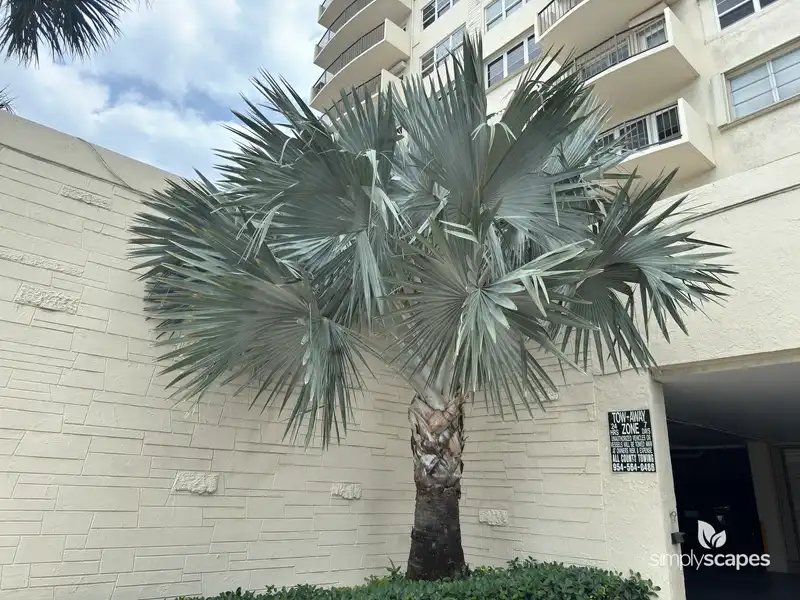
Bismarck Palm Tree
Bismarckia nobilis
A majestic silver-blue palm that commands attention in any landscape.
- Plant Type
- House Plants & Tropicals
- Width
- 12-16 Ft.
- Height
- 30-60 Ft.
- USDA hardiness zone
- 10 - 11
- Sun requirements
- Full Sun
- Design image count
- 11
Design images (11)


Bring your vision to life
The design images above are drag-and-drop ready — place this plant on a photo of your own yard and see it before you plant it.
Create design onlineAbout Bismarck Palm Tree
Bismarck palm is a solitary-trunk palm from Madagascar, prized for its broad fan leaves with a silver-green to blue-gray cast. Its large crown makes it a strong focal plant for an open, sunny landscape.
## Landscape use
UF/IFAS gives mature dimensions of about 30–60 feet tall and 12–16 feet wide, and notes that individual leaves can approach four feet across ([UF/IFAS profile](https://ask.ifas.ufl.edu/publication/ST101)). NC State Extension also describes it as a slow-growing specimen palm with silver-blue foliage ([NC State Extension](https://plants.ces.ncsu.edu/plants/bismarckia-nobilis/)). Allow room for the crown and keep it clear of buildings and overhead wires.
## Siting and seasonal interest
Choose full sun and a warm, protected location. UF/IFAS identifies zone 10A as the usual cold limit, with some sheltered zone 9B sites succeeding. NC State lists a wider range but warns of cold injury, so exposed sites should follow the more conservative guidance. The leaves provide the main ornamental display. Male and female flowers occur on separate palms, and female plants may develop brown fruit.
## Soil and water
Provide well-drained soil. Young palms need regular water while roots establish; mature plants tolerate some drought. Avoid prolonged waterlogging. UF/IFAS notes that potassium and other nutrient deficiencies can cause spotting and premature leaf loss.
## Maintenance
Give the crown ample room and avoid removing healthy green leaves. Watch older foliage for yellow-orange spotting or leaflet-tip damage, and follow local extension guidance for palm nutrition. Protect the palm from hard freezes and strong wind exposure.