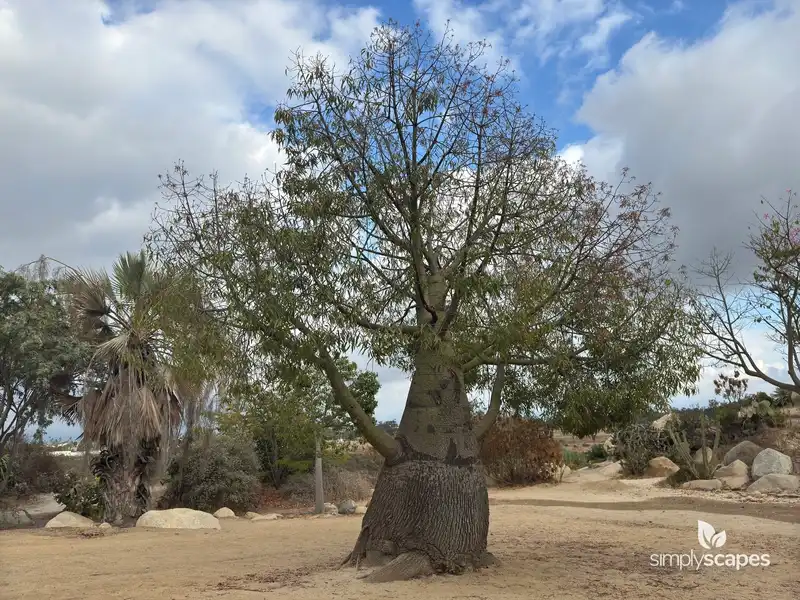
Queensland Bottle Tree
Brachychiton rupestris
An iconic Australian tree with a unique bottle-shaped trunk and drought-hardy nature.
- Plant Type
- Perennials & Annuals
- Width
- 7-13 Ft.
- Height
- 13-26 Ft.
- USDA hardiness zone
- 10 - 11
- Sun requirements
- Full Sun
- Design image count
- 1
Design images (1)

Bring your vision to life
The design images above are drag-and-drop ready — place this plant on a photo of your own yard and see it before you plant it.
Create design onlineAbout Queensland Bottle Tree
Queensland Bottle Tree is a distinctive Australian tree whose trunk swells with age into a water-storing bottle shape. The species can become a large landscape feature, with yellow bell-shaped flowers and variable leaves that may be shed before flowering.
## Form and landscape use
Use it as a specimen in a large, open garden or park where its trunk and canopy have room to develop. The Australian National Botanic Gardens reports mature trees up to 18–20 metres in the wild, often smaller in cultivation, with a canopy 5–12 metres across ([Australian National Botanic Gardens](https://www.anbg.gov.au/gnp/interns-2005/brachychiton-rupestris.html)). The Botanic Gardens of South Australia lists a cultivated range of 4–8 metres tall and 2–4 metres wide, plus yellow bell-shaped flowers ([Botanic Gardens of South Australia](https://plantselector.botanicgardens.sa.gov.au/Plants/Details/2942)).
## Siting and soil
Choose full sun and well-drained soil. The South Australian profile describes tolerance of clay, loam, and sandy soils, with minimal supplementary water once established. The distinctive trunk can be damaged by lawn equipment, so keep mowers and trimmers clear of its base. Royal Botanic Gardens Victoria classifies the species in Malvaceae ([HortFlora](https://hortflora.rbg.vic.gov.au/taxon/ad9151ac-5340-11e7-b82b-005056b0018f)).
## Maintenance
Allow substantial clearance for the developing trunk and canopy. Water young trees during establishment, then reduce supplemental watering once they are established. Handle seed pods carefully: the hairs surrounding the seeds can irritate skin, so wear gloves when collecting or cleaning them.