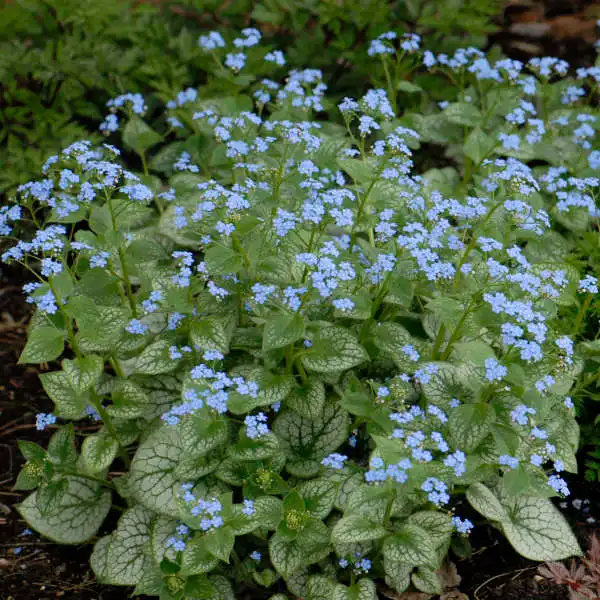
Jack Frost Brunnera
Brunnera macrophylla 'Jack Frost'
A shimmering shade-lover with silver heart-shaped leaves and sky-blue spring blooms.
- Plant Type
- Perennials & Annuals
- Width
- 12-15 In.
- Height
- 12-15 In.
- USDA hardiness zone
- 3 - 8
- Sun requirements
- Part Shade, Full Shade
- Water requirements
- Moderate
- Plant developer
- Terra Nova
- Design image count
- 1
Design images (1)

Bring your vision to life
The design images above are drag-and-drop ready — place this plant on a photo of your own yard and see it before you plant it.
Create design onlineAbout Jack Frost Brunnera
Brunnera macrophylla ‘Jack Frost’ forms a low mound of heart-shaped leaves with a frosted silver surface and green veins, followed by airy sprays of small light-blue, forget-me-not-like flowers in spring. This shade perennial works as a border accent or groundcover and keeps its foliage attractive when moisture is adequate.
## Foliage and flowering
The [CNB New Plants profile](https://cnbnewplants.nl/en/assortment/perennial-plants/jack-frost) identifies the cultivar as Brunnera macrophylla ‘Jack Frost’, with silver-gray leaves, blue flowers, and April-to-June flowering. The [University of Wisconsin Extension profile](https://hort.extension.wisc.edu/articles/brunnera-macrophylla-jack-frost/) describes a rounded mound about 1½ feet tall and wide, with flowers for several weeks in mid-spring. It notes that dry conditions can cause brown, tattered foliage.
## Siting and care
Plant in partial shade, ideally with morning light and afternoon shade, in moist, well-drained soil. Water during dry periods and mulch to conserve moisture. Wisconsin Extension lists USDA hardiness zones 3a–8b. Walters Gardens gives a compact 12–15 inch height and spread; provide partial shade and steady moisture to protect the foliage.
## Maintenance
Remove spent flower stalks if a tidier appearance is wanted, though this is not required. Cut away tattered leaves as needed, leaving old foliage in place over winter and removing it as spring growth begins.