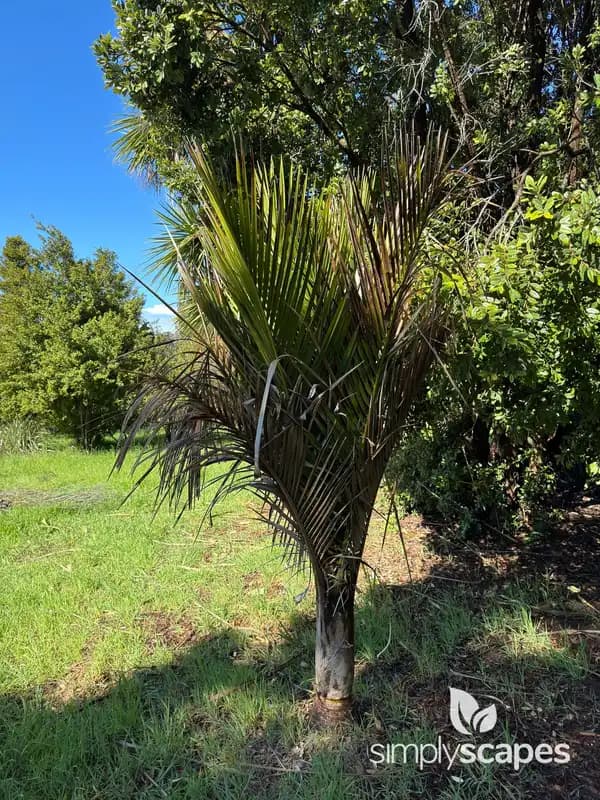
Jelly Palm
Butia capitata
A hardy, elegant palm with edible fruit and blue-green fronds.
- Plant Type
- House Plants & Tropicals
- Width
- 10-15 Ft.
- Height
- 20-35 Ft.
- USDA hardiness zone
- 9 - 12
- Sun requirements
- Full Sun, Part Shade
- Design image count
- 3
Design images (3)


Bring your vision to life
The design images above are drag-and-drop ready — place this plant on a photo of your own yard and see it before you plant it.
Create design onlineAbout Jelly Palm
Jelly palm (*Butia capitata*) is a slow-growing evergreen palm with arching gray-green leaves and edible yellow-orange fruit. Its mature size and botanical name vary across references, so allow room for a broad crown and check local usage when sourcing.
## Placement
Choose a sunny, sheltered position with moist but well-drained soil. The Royal Horticultural Society lists loam, sand, chalk, and clay as suitable soils and notes uses in coastal, courtyard, gravel, patio, and Mediterranean-style gardens. [RHS plant profile](https://www.rhs.org.uk/plants/28123/butia-capitata/details)
## Size and naming
Published dimensions differ: RHS gives a mature height of 4–8 m and spread of 1.5–2.5 m, while UF/IFAS describes the Florida pindo or jelly palm as reaching about 15–20 ft. UF/IFAS uses *Butia odorata* and says the palm was formerly called *B. capitata*; RHS currently accepts *B. capitata*. Retain the supplied name while recognizing that references may apply these names differently. [UF/IFAS profile](https://ask.ifas.ufl.edu/publication/ST105)
## Fruit
The flower stalks develop edible yellow-to-orange fruit. The species is slow-growing and can grow on dry or alkaline soils, according to UF/IFAS; its fruits are commonly made into jelly.
## Maintenance
RHS says routine pruning is not required. Container palms should be watered freely in summer and moved to a sheltered place or greenhouse during very cold weather.