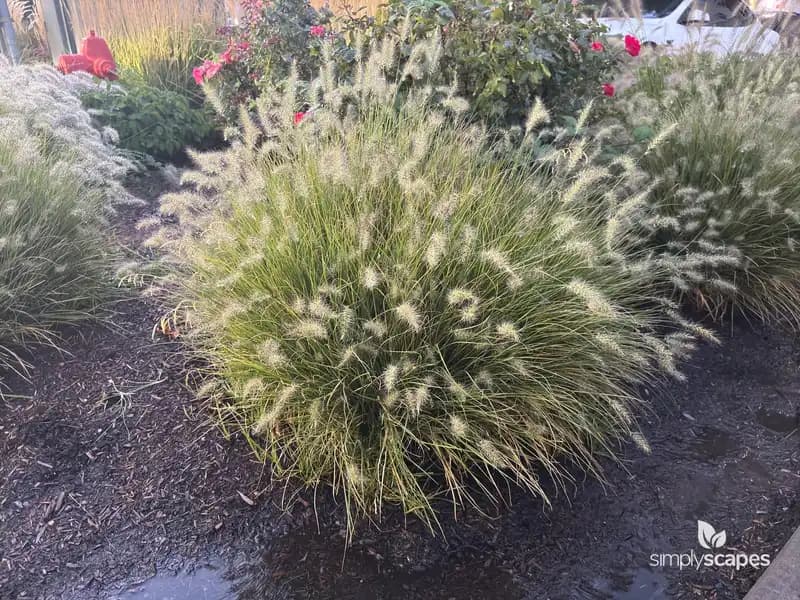
African Fountain Grass
Cenchrus setaceus
A graceful, drought-tolerant grass with striking purple plumes.
- Plant Type
- Ornamental Grasses
- Width
- 3-4 Ft.
- Height
- 2-4 Ft.
- USDA hardiness zone
- 8 - 11
- Sun requirements
- Full Sun, Part Shade
- Design image count
- 5
Design images (5)


Bring your vision to life
The design images above are drag-and-drop ready — place this plant on a photo of your own yard and see it before you plant it.
Create design onlineAbout African Fountain Grass
African fountain grass is a fine-textured clumping grass with arching leaves and feathery flower spikes. It is often grown as an annual in cooler regions and can persist as a perennial in warm climates, where its capacity to self-seed should be considered before planting.
## Form and flowering
The [North Carolina Extension Gardener Plant Toolbox](https://plants.ces.ncsu.edu/plants/cenchrus-setaceus/common-name/african-fountain-grass/) describes *Cenchrus setaceus* as a mounding, clumping grass about 2–4 feet tall that flowers from summer until frost and attracts birds. It lists sun to partial shade and notes that the plant spreads by seed and is invasive in some southern West Coast states. [UF/IFAS Extension](https://ask.ifas.ufl.edu/publication/fp463) describes narrow, arching leaves and pink to purple plumes, flowering from early summer to frost. Published mature heights vary: North Carolina lists 2–4 feet, while UF/IFAS lists 4–6 feet.
## Siting
Use a sunny, well-drained site; North Carolina permits partial shade, while UF/IFAS recommends full sun. Both sources describe use in borders and as an accent; UF/IFAS also lists containers and cut flowers. Hardiness references differ: North Carolina lists USDA Zones 9–11 and UF/IFAS Zones 8–10.
## Maintenance
Check local invasive-plant guidance before planting and remove unwanted seedlings before they set seed. Flower spikes can be cut for fresh arrangements. In cooler climates, expect the grass to be grown as an annual rather than a reliably overwintering perennial.