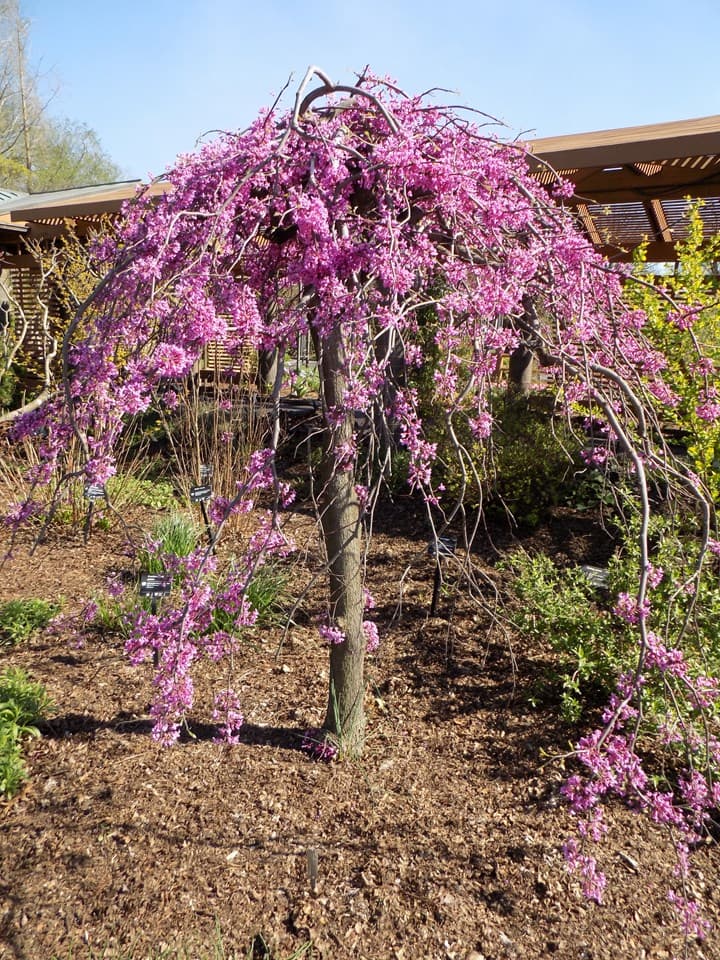
Covey Lavender Twist® Weeping Eastern Redbud
Cercis canadensis 'Covey' Lavender Twist®
A captivating weeping redbud with cascading branches and rosy-lavender spring blooms.
- Plant Type
- Flowering Trees
- Width
- 10 Ft.
- Height
- 8 Ft.
- USDA hardiness zone
- 5 - 9
- Sun requirements
- Full Sun, Part Shade
- Water requirements
- Moderate
- Design image count
- 5
Design images (5)


Bring your vision to life
The design images above are drag-and-drop ready — place this plant on a photo of your own yard and see it before you plant it.
Create design onlineAbout Covey Lavender Twist® Weeping Eastern Redbud
Covey, sold as Lavender Twist®, is a distinctive eastern redbud with contorted branches that arch downward into a compact, umbrella-like crown. Magenta-pink flowers appear on the bare branches in early spring before the green, heart-shaped leaves unfold ([Utah State University Botanical Center](https://extension.usu.edu/botanicalcenter/trees-of-varga-arboretum/lavender-twist-redbud), [US Plant Patent PP10,328](https://patents.google.com/patent/USPP10328P/en)).
## Size and Form
Plan for a small ornamental tree roughly 4–10 feet tall and wide, while allowing additional room if the crown spreads with age. The twisted limbs and pendulous branchlets make it a natural specimen for a lawn, courtyard, or prominent garden bed. The cultivar patent describes its low leader and arching branches as defining features ([US Plant Patent PP10,328](https://patents.google.com/patent/USPP10328P/en)).
## Site and Seasonal Interest
Give it full sun or part shade and moist, well-drained soil. Spring flowers are followed by green foliage; the leaves turn yellow in fall. A site with consistent moisture and good drainage helps avoid stress, especially during establishment ([Utah State University Botanical Center](https://extension.usu.edu/botanicalcenter/trees-of-varga-arboretum/lavender-twist-redbud), [Dawes Arboretum](https://dawesarb.arboretumexplorer.org/taxon.aspx?t=20764)).
## Maintenance
Water while establishing and during extended dry weather. Prune selectively after flowering to clear damaged growth or preserve access beneath the canopy; avoid removing the contorted framework that gives this cultivar its character.