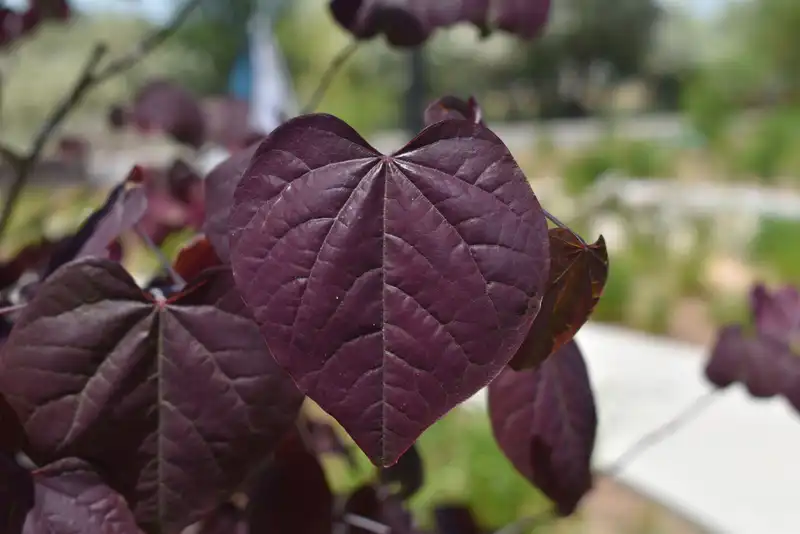
Black Pearl™ Redbud Tree
Cercis canadensis 'JN16'
A dramatic redbud with intense, near-black foliage and vibrant spring blooms.
- Plant Type
- Flowering Trees
- Width
- 20-25 Ft.
- Height
- 15-20 Ft.
- USDA hardiness zone
- 5 - 9
- Sun requirements
- Full Sun, Part Shade
- Design image count
- 2
Design images (2)


Bring your vision to life
The design images above are drag-and-drop ready — place this plant on a photo of your own yard and see it before you plant it.
Create design onlineAbout Black Pearl™ Redbud Tree
Black Pearl™ is the JN16 selection of eastern redbud, recognized for deep purple foliage that holds its color into summer. Pink-purple flowers appear on the bare branches in early spring, followed by heart-shaped leaves that create a dark backdrop through the growing season ([Jordan Valley Conservation Garden Park](https://conservationgardenpark.jvwcd.gov/plants/3005/black-pearl-eastern-redbud), [US Plant Patent PP28,627](https://patents.google.com/patent/USPP28627P3/en)).
## Size and Form
Allow room for a tree about 15–20 feet tall and 20–25 feet wide. Its broad oval crown and foliage color make it a specimen for a lawn or mixed planting with enough space to show its silhouette. The patent describes the cultivar as compact, with relatively short internodes and strong summer color retention ([US Plant Patent PP28,627](https://patents.google.com/patent/USPP28627P3/en), [Smithsonian Gardens](https://si.gardenexplorer.org/taxon-39375.aspx)).
## Site and Seasonal Interest
Plant in full sun to part shade in well-drained soil. Spring flowers open before the leaves; the foliage is nearly black-purple in summer and turns yellow in fall. The published hardiness range is USDA zones 5–9 ([Jordan Valley Conservation Garden Park](https://conservationgardenpark.jvwcd.gov/plants/3005/black-pearl-eastern-redbud), [Smithsonian Gardens](https://si.gardenexplorer.org/taxon-39375.aspx)).
## Maintenance
Water during establishment and extended dry periods. Remove dead or crossing branches when needed, and retain the natural branching structure. Give the mature crown room to spread so its foliage and spring display remain visible.