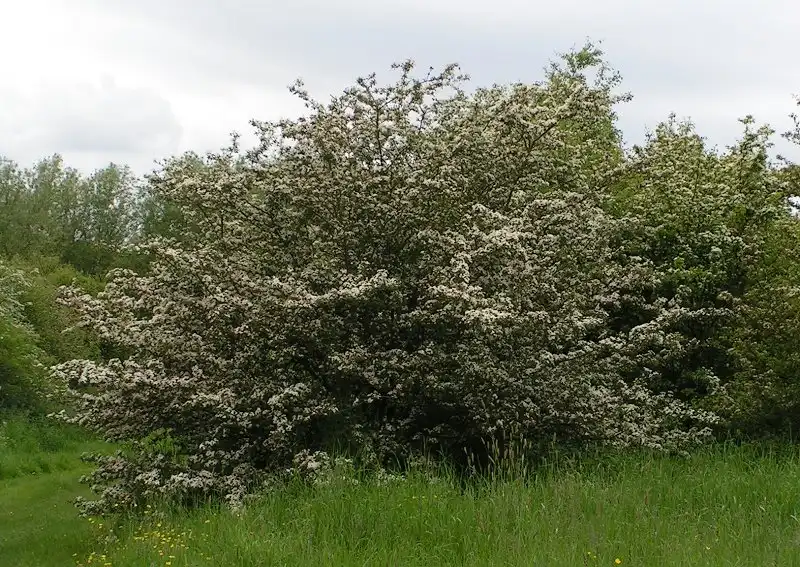
Common Hawthorn
Crataegus monogyna
A classic wildlife-friendly hedge with fragrant spring blooms and red autumn berries.
- Plant Type
- Shade Trees
- Width
- 20-25 Ft.
- Height
- 25-30 Ft.
- USDA hardiness zone
- 4 - 7
- Sun requirements
- Full Sun, Part Shade
- Design image count
- 3
Design images (3)


Bring your vision to life
The design images above are drag-and-drop ready — place this plant on a photo of your own yard and see it before you plant it.
Create design onlineAbout Common Hawthorn
Common hawthorn is Crataegus monogyna, also called one-seed or single-seeded hawthorn. It is a deciduous, thorny tree with deeply lobed leaves, white spring flowers, and red fruit containing a single stone. [Oregon State University](https://landscapeplants.oregonstate.edu/plants/crataegus-monogyna) · [Royal Horticultural Society](https://www.rhs.org.uk/plants/4775/crataegus-monogyna/details)
## Features and placement
The crown is dense and rounded, making the species useful as a specimen or hedge where its spiny branches can be kept clear of regular foot traffic. Oregon State describes a typical height of about 20–30 feet and notes thorns up to roughly an inch long; the RHS gives broader mature ranges of 4–8 metres for height and spread. The foliage is glossy green and can turn gold in autumn. Flat clusters of fragrant, creamy-white flowers appear in late spring, followed by dark red autumn fruit.
## Maintenance
Grow in full sun or partial shade in well-drained soil. Water new plantings while they establish, then adapt watering to rainfall and soil conditions. Hawthorn fruit is not a general food recommendation: the RHS notes that seeds contain toxins and should be removed if fruit is being considered for food. Oregon State lists common hawthorn as hardy to USDA Zone 4; local winter exposure and site conditions still matter. Preserve the existing one-seed aliases when labeling this species, and leave room for its mature crown and thorny branches. [RHS growing conditions and harm note](https://www.rhs.org.uk/plants/4775/crataegus-monogyna/details) · [Oregon State University](https://landscapeplants.oregonstate.edu/plants/crataegus-monogyna)