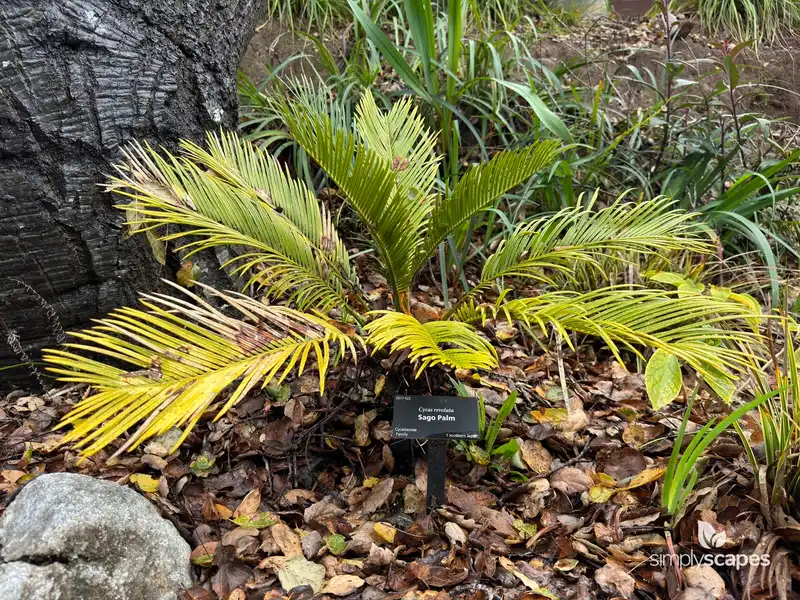
Sago Palm Tree
Cycas revoluta
A timeless living fossil with architectural foliage for a bold, tropical statement.
- Plant Type
- House Plants & Tropicals
- Width
- 3-10 Ft.
- Height
- 3-10 Ft.
- USDA hardiness zone
- 8 - 12
- Sun requirements
- Part Shade
- Design image count
- 14
Design images (14)


Bring your vision to life
The design images above are drag-and-drop ready — place this plant on a photo of your own yard and see it before you plant it.
Create design onlineAbout Sago Palm Tree
Sago palm (Cycas revoluta) is a very slow-growing cycad with a short trunk and a crown of glossy, stiff, palm-like fronds. It is a long-lived architectural specimen for a warm landscape or a bright indoor space, although it is not a true palm ([NC State Extension](https://plants.ces.ncsu.edu/plants/cycas-revoluta/), [N.C. Cooperative Extension](https://craven.ces.ncsu.edu/news/sago-palm-worth-the-trouble-in-eastern-nc/)).
## Size and Form
Mature plants can range from a few feet to around 10 feet tall and wide, and growth is extremely slow. NC State describes a plant that may take 50 years or more to reach 10 feet. The rigid, glossy leaflets end in sharp tips, so allow room around paths and seating areas ([NC State Extension](https://plants.ces.ncsu.edu/plants/cycas-revoluta/)).
## Site and Seasonal Interest
Provide bright, filtered light or part shade and well-drained soil. Keep the root zone moist but do not overwater; established plants tolerate dry periods. Sago palm is suitable in USDA Zone 8b and warmer, while frost can damage its foliage ([NC State Extension](https://plants.ces.ncsu.edu/plants/cycas-revoluta/), [N.C. Cooperative Extension](https://craven.ces.ncsu.edu/news/sago-palm-worth-the-trouble-in-eastern-nc/)).
## Maintenance
Remove dead fronds at the base as needed. All parts are poisonous, so keep the plant away from children and pets; never treat its edible-starch references as advice to eat it without expert processing ([NC State Extension](https://plants.ces.ncsu.edu/plants/cycas-revoluta/)).
## Yavapai County — 2025 source scope and care
The [University of Arizona Yavapai County bulletin](https://extension.arizona.edu/sites/default/files/2025-03/FirewisePlants3-14-2025.pdf), page 2, lists Sago palm with the botanical cell Cycas revoluta and form T. It places this entry in its fire-resistant list. The matched catalog name is Cycas revoluta.
Source form codes: C=groundcover, G=grass, P=perennial, S=shrub, T=tree and V=vine. Printed names and form codes can include source spelling errors or historical taxonomic treatments; the source wording is retained separately from the catalog name and plant-specific habit.
The bulletin states that resistant plants require irrigation and frequent maintenance. It describes low shrubs or clean taller shrubs with little dead material. Maintain suitable moisture and spacing, remove dead growth and avoid continuous fuel; a regional list does not establish every selection's performance or local cold hardiness.
No plant is fireproof. Keep this Yavapai classification separate from Arizona UA, Utah, New Mexico, Idaho, Colorado and other source ratings and their placement, moisture and maintenance conditions.