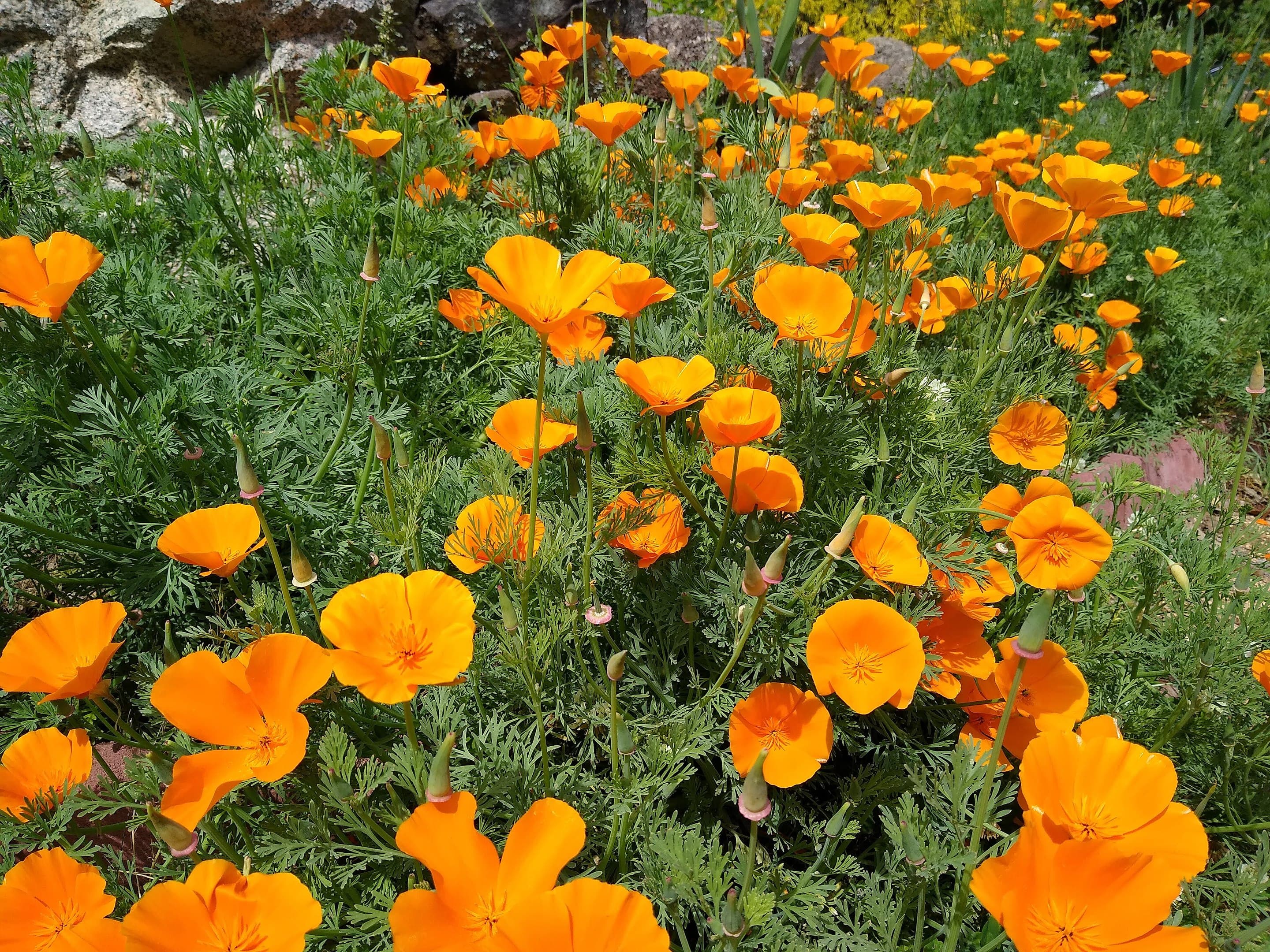
California Poppy
Eschscholzia californica
Vibrant golden blooms for sun-drenched, drought-tolerant landscapes.
- Plant Type
- Annuals
- Width
- 12-24 In.
- Height
- 12-24 In.
- USDA hardiness zone
- 6 - 10
- Sun requirements
- Full Sun, Part Shade
- Water requirements
- Low
- Design image count
- 1
Design images (1)

Bring your vision to life
The design images above are drag-and-drop ready — place this plant on a photo of your own yard and see it before you plant it.
Create design onlineAbout California Poppy
California poppy (*Eschscholzia californica*) is a fine-textured wildflower with feathery blue-green foliage and orange to yellow, cup-shaped flowers. It forms a loose mound and flowers from spring into summer, while climate and population affect whether it behaves as an annual or short-lived perennial ([North Carolina Extension](https://plants.ces.ncsu.edu/plants/eschscholzia-californica/), [USDA NRCS](https://plants.sc.egov.usda.gov/DocumentLibrary/plantguide/pdf/pg_esca2.pdf)).
## Garden Use
Use it in sunny borders, rock gardens, containers, or naturalized meadow patches where its bright flowers can mingle with other plants suited to dry conditions. Mature plants are commonly about 1–2 feet tall and wide, though individual populations and conditions vary.
## Site and Season
Choose full sun and well-drained soil; the species tolerates lean ground and does not perform well where water pools or soil stays saturated. Direct sowing is generally easier than transplanting because established plants develop a taproot. Leave a few seed capsules if you want seedlings to return.
## Maintenance
Water sparingly after establishment and avoid rich, persistently wet soil. Deadhead to extend flowering or allow some seed to mature for natural reseeding.
## Nevada UNR compilation — source scope
The [UNR compilation](https://extension.unr.edu/publication.aspx?PubID=4762) lists Eschscholzia spp. (California poppy) in its forbs table, for Sunset climate zones 1a,2a,2b,10,11,13. This species is a narrower representative of that broad entry, not proof of complete group coverage or individual assessment of every species or cultivar. UNR reports earlier publications and does not independently assert reduced flammability. Sunset zones are separate from USDA hardiness ratings. Check local suitability, watering, spacing and removal of dead vegetation; no plant is fireproof.
## Inland West — source row reconciliation
PDF page 18 (printed 16), General list: “Eschscholzia californica” / “California poppy”. Exact source species or reconciled historical spelling/synonym; unselected record used.
## Inland West — 2005 source scope and care
The [University of Idaho Station Bulletin 67, January 2005](https://www.uwyo.edu/barnbackyard/_files/documents/resources/mullenfire/protectinghomeswildfire.pdf) includes this taxon in its plant suggestions. The publication says the list is not exhaustive and no plant is fireproof; pruning, watering, plant condition and landscape arrangement matter more than selection alone. Choose for slope, aspect, hardiness and rainfall, and keep this association separate from numerical Idaho BLM scores and other regional ratings.
Its landscape guidance describes a treated landscape extending at least 100 feet from the home, with greater distances on steep or windy sites. Separate tree crowns by 10–15 feet; keep foundation plantings low, well watered and free of dead material, eliminate ladder fuels and use separated planting groups with nonflammable breaks. Maintain irrigation, trim turf and remove dry debris. The same species can behave differently with water stress or accumulated dead growth; verify current local guidance and suitability.