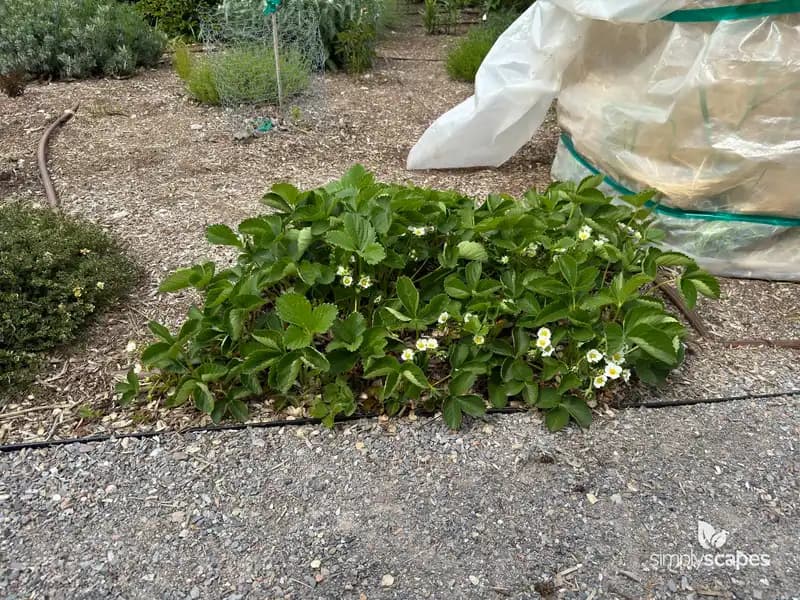
Strawberry Plant
Fragaria
The ultimate home-grown treat: sweet, sun-ripened strawberries for every garden.
- Plant Type
- Edible Plants
- Width
- 10-18 In.
- Height
- 8-12 In.
- USDA hardiness zone
- 5 - 8
- Sun requirements
- Full Sun, Part Shade
- Design image count
- 1
Design images (1)

Bring your vision to life
The design images above are drag-and-drop ready — place this plant on a photo of your own yard and see it before you plant it.
Create design onlineAbout Strawberry Plant
Fragaria is the strawberry genus in the rose family. Its perennial herbs generally have trifoliate leaves clustered near the crown, and their fleshy edible portion develops around many small achenes. Species and cultivars differ in size, runner production, hardiness and harvest timing, so choose care and spacing for the named strawberry rather than treating the genus as one uniform garden plant.
## Garden use and harvest
Strawberries are grown for their fruit and can also cover soil in a productive bed. The [Royal Botanic Gardens, Kew profile for Fragaria](https://powo.science.kew.org/taxon/urn:lsid:ipni.org:names:30014957-2/general-information) describes the genus and its botanical fruit structure. [NC State Extension](https://plants.ces.ncsu.edu/plants/fragaria-x-ananassa/common-name/strawberries/) describes cultivated garden strawberries as edible perennials and lists groundcover, raised-bed and container uses; those dimensions and hardiness zones refer to cultivated garden strawberry, not every Fragaria species.
## Growing conditions
For common garden strawberries, full sun to partial shade and moist, well-drained soil support flowering and fruit. Shallow roots need regular water, particularly during bloom and berry fill. Allow enough room for the selected cultivar’s mature spread and runners, or remove runners when a compact bed is preferred.
## Maintenance
Remove ripe fruit and damaged foliage, and keep the planting open enough for air movement. Replace or renovate plants according to their bearing type and local growing conditions. Check species-specific hardiness and spacing before planting, since alpine and woodland strawberries can behave differently from larger garden hybrids.
## Pacific Northwest Firewise source
The [PNW 590 guide](https://extension.oregonstate.edu/gallery/fire-resistant-plant-profiles-groundcovers) profiles wild strawberries as a group and mentions Fragaria vesca. It cautions against beach strawberry (F. chiloensis) in its context; check local native range and invasiveness guidance. This genus-level listing does not independently assess every species or cultivar. Maintain spacing and follow local site and maintenance guidance.
## FireSmart BC placement
The [FireSmart BC chart](https://firesmartbc.ca/landscaping-hub/fire-resistant-plants/) lists native wild strawberry, Fragaria at genus level, in the Intermediate zone. This source entry does not independently rate every species or cultivar. Follow its placement and maintenance guidance.
## Colorado CSU/CSFS 2025 source
The [July 2025 Ignition-Resistant Landscape Plants guide](https://csfs.colostate.edu/wp-content/uploads/2025/08/CSFS_CSU-Ext_Fact-Sheets_IRLP_2025_081825-2_web_accessible.pdf) prints “Fragariaspp.” for its wild-strawberry genus group in its non-native low-water flowers and groundcovers table and assigns ignitability score 9. In this system, 10 is least ignitable. The wild-strawberry scope does not independently rate garden strawberry hybrids. This is the corresponding genus-level record; the table does not establish independent testing of every species or named cultivar.
For this source row, water needs are medium, the site is full sun to partial shade, approximate height is 0.25-0.75 feet, and the stated elevation range is 5-11 thousand feet. These are the guide's example conditions, not universal dimensions or care requirements for every member of the genus. Keep plants appropriately watered, remove dead material, preserve spacing and avoid fuel connections. No plant is fireproof; use the guide's placement and maintenance instructions.
## Nevada UNR High Fire Hazard Areas compilation
The [UNR compilation](https://extension.unr.edu/publication.aspx?PubID=4762) includes this genus in the following source context: Forbs: Wild strawberries, Sunset climate zones 2b,10,11,13. It reports earlier publications and explicitly does not independently assert that listed plants are less flammable. This genus-level association does not establish individual assessment of every species or cultivar. The source identifies wild strawberries; this broad genus record also includes cultivated forms, whose inclusion is not established. Its climate zones are Sunset zones, not USDA hardiness ratings. Check local suitability, watering, spacing, removal of dead material and defensible-space requirements; no plant is fireproof.
## Pacific Northwest — PNW 590 (2023): Wild strawberry
The [groundcovers-12 profile](https://extension.oregonstate.edu/gallery/fire-resistant-plant-profiles-groundcovers) provides this source context. Primary heading: Fragaria species. Exact source genus scope; no individual species/cultivar testing inferred.
Source care: Low water use; Full sun to partial shade. The body explicitly gives Fragaria vesca as its native example and says to avoid F. chiloensis. That is the publication's regional avoidance instruction, not a claim that beach strawberry is nonnative everywhere. Keep the exclusion attached to the broad genus record.
Profile reference data: Height: 8–10 inches; Spread: 24–36 inches; USDA hardiness zones: 5–9; Flowers: white or pink; Bloom time: May–July. These are the publication's profile-level reference values; they are not independent measurements of each named example or a change to this catalog record's scalar fields. Availability of native forms, pollinator use and deer resistance remain source-scope statements, not automatic attribute tags.
The [2023 guide](https://extension.oregonstate.edu/catalog/pnw-590-fire-resistant-plants-home-landscapes) requires healthy, adequately watered plants and removal of dead/spent material. Keep the first 5 feet around the home free of plants; in the 5–30-foot zone separate planting groups by at least 10 feet, farther on slopes. Avoid continuous rows and ladder fuels, and keep tree branches at least 15 feet from the home. Source association is not a laboratory flammability score or a claim of fireproofness. This paragraph identifies 2023 scope; older PNW associations and other regional ratings remain separate.