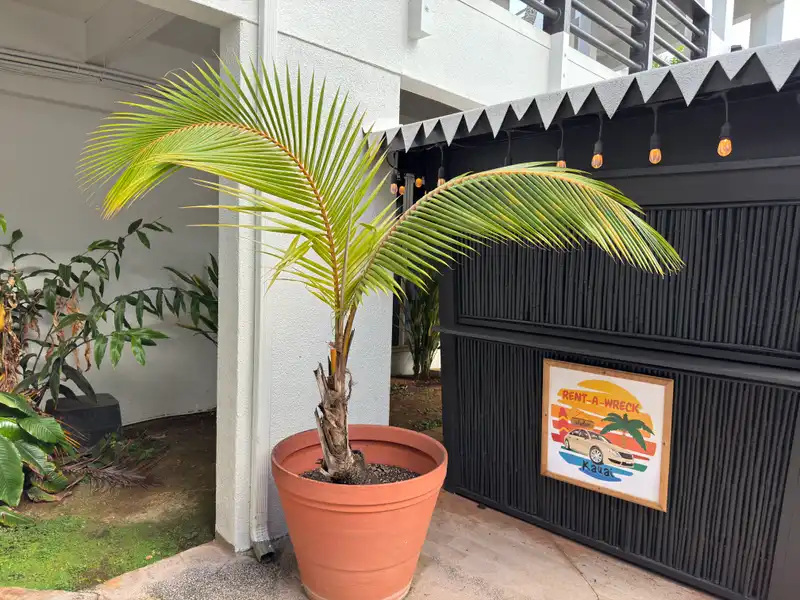
Kentia palm
Howea forsteriana
- Plant Type
- House Plants & Tropicals
- Width
- 6-10 Ft.
- Height
- 40 Ft.
- USDA hardiness zone
- 9 - 11
- Sun requirements
- Part Shade
- Design image count
- 1
Design images (1)

Bring your vision to life
The design images above are drag-and-drop ready — place this plant on a photo of your own yard and see it before you plant it.
Create design onlineAbout Kentia palm
Howea forsteriana, the Kentia palm, is an evergreen, single-stemmed palm native to Lord Howe Island and valued for its graceful arching fronds. In a landscape it can reach about 40 ft tall with a 6–10 ft spread; North Carolina State lists USDA zones 9b–11b. Indoors it grows slowly and is commonly kept in a container. [University of Florida IFAS Extension](https://ask.ifas.ufl.edu/publication/ST297) [North Carolina Extension Gardener Plant Toolbox](https://plants.ces.ncsu.edu/plants/howea-forsteriana/)
## Form and placement
The dark-green, feather-shaped leaves make Kentia a strong focal point in a room or sheltered outdoor setting. It tolerates moderate indoor light and is often used as a houseplant; outside, shade to partial shade is preferred, though it can adapt to more sun when protected from direct exposure. UF/IFAS describes moderate salt-spray tolerance and suitability for coastal landscapes.
## Flowers and growing conditions
Creamy-white flowers form below the leaves in late fall and winter, with UF/IFAS reporting flowering in November and December. Use a well-drained, humus-rich potting mix that stays lightly moist. The palm tolerates some dryness, but severe drying and continual overwatering can both cause problems.
## Care and handling
This is a slow-growing palm that seldom needs repotting. Watch older leaves for potassium deficiency and new growth for signs of manganese or boron deficiency; spider mites, mealybugs, and scale can also occur. [North Carolina Extension Gardener Plant Toolbox](https://plants.ces.ncsu.edu/plants/howea-forsteriana/) [University of Florida IFAS Extension](https://ask.ifas.ufl.edu/publication/ST297)
## Maintenance
Water when the upper mix begins to dry, then let excess drain freely. Avoid prolonged dryness and waterlogged roots.