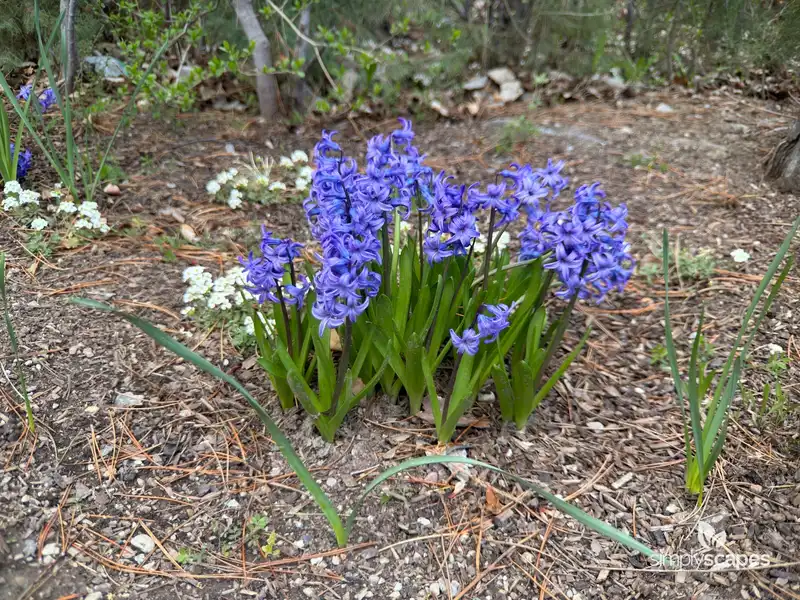
Hyacinth
Hyacinthus orientalis
Intensely fragrant spring blooms for stunning garden borders and indoor forcing.
- Plant Type
- Perennials & Annuals
- Width
- 3–6 In.
- Height
- 8–12 In.
- USDA hardiness zone
- 4 - 8
- Sun requirements
- Full Sun, Part Shade
- Design image count
- 13
Design images (13)


Bring your vision to life
The design images above are drag-and-drop ready — place this plant on a photo of your own yard and see it before you plant it.
Create design onlineAbout Hyacinth
Common hyacinth (Hyacinthus orientalis) is a bulbous perennial that sends up dense, fragrant spikes of tubular spring flowers above basal clumps of strap-shaped green leaves. It is usually about 8–12 inches tall with a compact 3–6-inch spread, and its flower colors vary among cultivars. [North Carolina State Extension](https://plants.ces.ncsu.edu/plants/hyacinthus-orientalis/) describes mid-spring bloom, fragrance, and outdoor care; the [Royal Horticultural Society profile](https://www.rhs.org.uk/plants/53644/hyacinthus-orientalis/details) lists a comparable 30-centimeter height and spring flowering.
## Siting and seasonal use
Grow bulbs in full sun or partial shade in moisture-retentive but well-drained soil; rich loam is suitable, and standing water can cause bulb rot. Hyacinths are effective in grouped border plantings and containers, including indoor forcing for seasonal color. Outdoors, flowers may become smaller and more widely spaced over successive years, so treat them as a spring accent rather than expecting every old clump to retain nursery-level density. North Carolina State Extension lists the species for USDA zones 4a–8b; its zone-four guidance recommends winter mulch.
## Flowering notes
The species is widely offered in named cultivars with blue, purple, pink, red, yellow, orange, and white blooms. The generic species record does not identify one color selection, so color is best read as cultivar-dependent. Fragrant flower spikes also suit cutting, and the extension notes that bees visit them.
## Maintenance
Use gloves when planting bulbs if skin is sensitive, since the extension notes possible contact dermatitis. Remove faded flower spikes for tidiness and divide crowded clumps; allow the foliage to finish its seasonal cycle before clearing the bed.