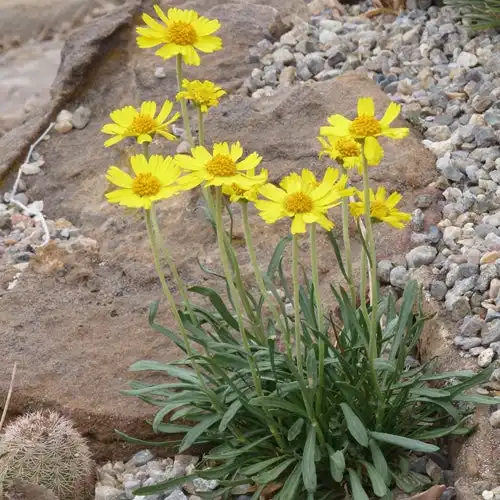
Sundancer Daisy Western Sundancer Daisy
Hymenoxys acaulis
A resilient, sun-loving perennial with cheerful yellow daisies for rock gardens.
- Plant Type
- Perennials & Annuals
- Width
- 12-18 In.
- Height
- 3-18 In.
- USDA hardiness zone
- 4 - 9
- Sun requirements
- Full Sun
- Water requirements
- Low
- Design image count
- 5
Design images (5)


Bring your vision to life
The design images above are drag-and-drop ready — place this plant on a photo of your own yard and see it before you plant it.
Create design onlineAbout Sundancer Daisy Western Sundancer Daisy
Sundancer Daisy, also called Angelita daisy and stemless four-nerve daisy, is a low, clump-forming perennial with basal leaves and bright yellow, daisy-like flowers. In sunny, well-drained sites it produces successive waves of bloom from spring into fall, bringing a long display to rock gardens and dry borders ([Utah State and Wyoming Extension](https://cwelwnp.usu.edu/westernnativeplants/plantlist_view.php?id=79&name=hymenoxysacaulistetraneurisacaulis), [Arizona Cooperative Extension](https://yavapaiplants.extension.arizona.edu/tetraneuris-acaulis), [Red Butte Garden](https://redbuttegarden.org/plants/species/1225/?sort=plant_id)).
## Names and form
Botanical references treat *Hymenoxys acaulis* as a synonym of *Tetraneuris acaulis*; Kew lists *T. acaulis* var. *acaulis* as accepted, while western extension and garden profiles use the binomial. These are species-level names, not proof of a separate cultivar denomination ([Kew Plants of the World Online](https://powo.science.kew.org/taxon/125964-2), [Kew accepted taxon](https://powo.science.kew.org/taxon/urn:lsid:ipni.org:names:77233265-1)). Forms vary in foliage color and flowering-stem height. A Red Butte Garden specimen is listed at about 5 inches high and 12 inches wide; extension descriptions note a 3–6-inch foliage tuft before bloom and flowering stems reaching 18 inches. Other listings give maxima near 12 by 18 inches, so leave room for flowering stems and a modest spread.
## Siting
Full sun promotes the best flowering. The plant tolerates dry to moderately moist soils when drainage is good, and supplemental water can prolong the bloom display. Use it at the front of a sunny border, in rock gardens, or grouped through a dry meadow or pollinator planting. Kew records a native range from west-central Canada through much of the central United States; local garden performance still depends on drainage and exposure.
## Maintenance
Remove spent flower heads for a tidy appearance and to encourage further bloom. Some seedlings may appear, but western extension reports they are easy to control rather than aggressive. Water during establishment, then adjust supplemental watering to the soil and desired flowering period; avoid persistently wet ground ([Utah State and Wyoming Extension](https://cwelwnp.usu.edu/westernnativeplants/plantlist_view.php?id=79&name=hymenoxysacaulistetraneurisacaulis)).