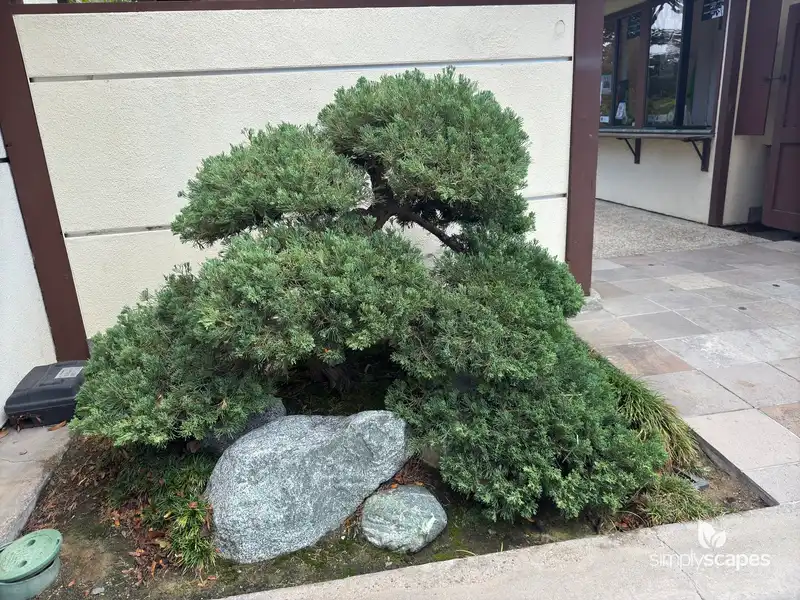
Juniper Trees
Juniperus
Versatile evergreens with iconic berries and year-round color.
- Plant Type
- Conifer Trees
- Width
- 5-15 Ft.
- Height
- 10-50 Ft.
- USDA hardiness zone
- 2 - 9
- Sun requirements
- Full Sun
- Design image count
- 1
Design images (1)

Bring your vision to life
The design images above are drag-and-drop ready — place this plant on a photo of your own yard and see it before you plant it.
Create design onlineAbout Juniper Trees
[Kew](https://powo.science.kew.org/taxon/60436243-2) accepts Juniperus as a genus in Cupressaceae. Depending on the species, junipers grow as creeping groundcovers, spreading shrubs, or large trees, and their foliage may be needle-like or scale-like. Choose a named species or cultivar when you need predictable mature size and form.
## Form and landscape use
Junipers add year-round foliage and structural texture. Upright selections can serve as screens or specimens, while low, spreading kinds cover soil, edges, and slopes. Female plants of some species produce fleshy, berry-like cones; birds and small mammals eat them and disperse the seeds. Cone color and foliage character vary among species.
## Growing conditions
Full sun and well-drained soil suit many junipers, though some tolerate partial shade. Water and climate needs differ across the genus, so check the chosen species or cultivar before planting. Allow for its mature spread and avoid treating one juniper’s dimensions as typical of all others. [North Carolina State Extension](https://plants.ces.ncsu.edu/plants/juniperus/) notes that junipers span creeping groundcovers to trees and that their foliage and growing needs vary by species.
## Maintenance
Junipers are generally low-maintenance once established in an appropriate site. Remove dead or damaged branches and use species-specific guidance before substantial pruning. Watch for regionally relevant pests and diseases, including scale, mites, twig blight, and rust on susceptible plants.
The 2025 Yavapai County guide lists Juniperus at genus scope among fire-prone plants. This is a fire-hazard warning, not an individual assessment of every species or cultivar. Follow the guide's placement and maintenance guidance.
## FireSmart BC hazard warning
[FireSmart BC](https://firesmartbc.ca/landscaping-hub/fire-resistant-plants/#fire-hazards) lists Juniperus as Highest Risk in its fire hazard table. This is a broad genus-level warning, not an individual assessment of every species or cultivar; follow local placement and maintenance guidance.
## Yavapai County — 2025 source scope and care
The [University of Arizona Yavapai County bulletin](https://extension.arizona.edu/sites/default/files/2025-03/FirewisePlants3-14-2025.pdf), page 3, lists Juniper with the botanical cell Juniperus sp. and form S. It places this entry in its fire-prone list. The matched catalog name is Juniperus. This source row is coded shrub form S for Juniperus. The genus includes trees and shrubs; the printed shrub scope does not establish all juniper selections individually.
Source form codes: C=groundcover, G=grass, P=perennial, S=shrub, T=tree and V=vine. Printed names and form codes can include source spelling errors or historical taxonomic treatments; the source wording is retained separately from the catalog name and plant-specific habit.
The bulletin warns that fire-prone plants can ignite readily and burn intensely, and should be removed or aggressively maintained when near a home, road or driveway. For native trees it calls for removing dead material, keeping limbs out of the lower 6–10 feet and clearing shrubs beneath the canopy. For other fire-prone natives it calls for isolated stands more than 30 feet from structures. Apply current local requirements and pruning suited to the identified plant.
No plant is fireproof. Keep this Yavapai classification separate from Arizona UA, Utah, New Mexico, Idaho, Colorado and other source ratings and their placement, moisture and maintenance conditions.