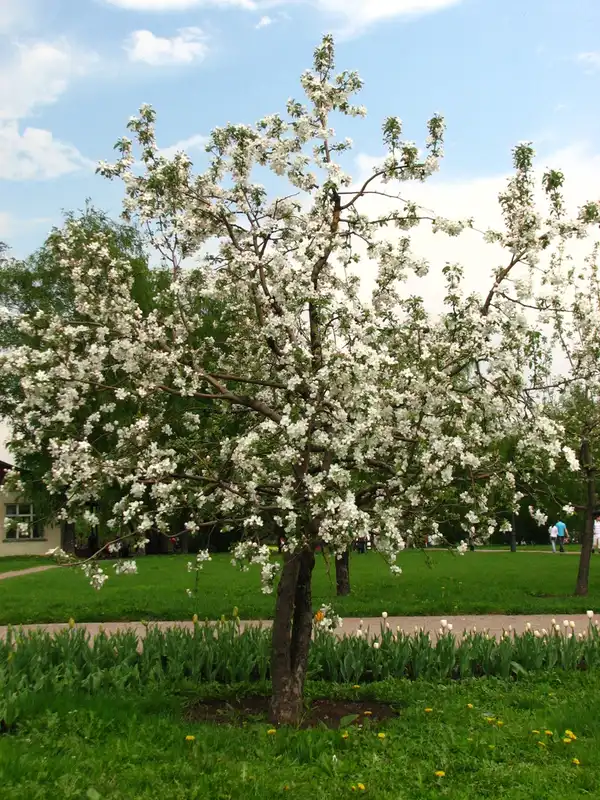
Apple Tree
Malus domestica
The iconic orchard tree for crisp, homegrown fruit and spring blossoms.
- Plant Type
- Edible Plants
- Width
- 15-30 Ft.
- Height
- 32 Ft.
- USDA hardiness zone
- 4 - 9
- Sun requirements
- Full Sun
- Design image count
- 7
Design images (7)


Bring your vision to life
The design images above are drag-and-drop ready — place this plant on a photo of your own yard and see it before you plant it.
Create design onlineAbout Apple Tree
Apple is the familiar deciduous fruit tree Malus domestica, grown for spring blossoms and edible fruit. A tree’s eventual size depends strongly on its rootstock and training: standard seedling-rootstock trees may reach about 25–30 feet, while dwarf and semi-dwarf trees stay smaller ([NC State Extension](https://plants.ces.ncsu.edu/plants/malus-domestica/common-name/apple/); [Iowa State University Extension](https://yardandgarden.extension.iastate.edu/how-to/growing-apples-home-garden)).
## Garden Use
Choose an apple cultivar and rootstock that suit the available space and local climate. Apples can be trained as fruiting orchard trees or grown as flowering specimens. The broad size range in this record describes the species; it does not predict the mature dimensions of an unidentified cultivar or graft combination.
## Siting and Pollination
Plant in full sun in well-drained soil and water new trees regularly while their roots establish. Most apple cultivars set a better crop when a compatible, co-blossoming cultivar grows nearby; a species name alone does not identify the right pollinator. Check cultivar bloom timing and pollination compatibility before planting ([Iowa State University Extension](https://yardandgarden.extension.iastate.edu/faq/what-cultivar-apple-should-i-plant-ensure-good-pollination)).
## Maintenance
Prune to maintain a strong framework and accessible canopy, and thin excess fruit when young to protect branches and improve fruit size. Monitor for common apple pests and diseases; management needs vary by cultivar and growing region. Confirm rootstock and cultivar details with the nursery before setting final spacing or expecting a particular harvest ([NC State Extension](https://plants.ces.ncsu.edu/plants/malus-domestica/common-name/apple/); [Iowa State University Extension](https://yardandgarden.extension.iastate.edu/how-to/growing-apples-home-garden)).
## Yavapai County — 2025 source scope and care
The [University of Arizona Yavapai County bulletin](https://extension.arizona.edu/sites/default/files/2025-03/FirewisePlants3-14-2025.pdf), page 1, lists Fruit (apples, pears, peaches, cherry) with the botanical cell (no botanical name supplied) and form T. It places this entry in its fire-resistant list. The matched catalog name is Malus domestica. Four named fruit groups are represented separately by unselected Malus domestica (apple), Pyrus communis (pear), Prunus persica (peach) and Prunus avium (cherry). The bulletin does not name these species or individually assess their cultivars; the row remains a qualified common-group match.
Source form codes: C=groundcover, G=grass, P=perennial, S=shrub, T=tree and V=vine. Printed names and form codes can include source spelling errors or historical taxonomic treatments; the source wording is retained separately from the catalog name and plant-specific habit.
The bulletin states that resistant plants require irrigation and frequent maintenance. It describes low shrubs or clean taller shrubs with little dead material. Maintain suitable moisture and spacing, remove dead growth and avoid continuous fuel; a regional list does not establish every selection's performance or local cold hardiness.
No plant is fireproof. Keep this Yavapai classification separate from Arizona UA, Utah, New Mexico, Idaho, Colorado and other source ratings and their placement, moisture and maintenance conditions.