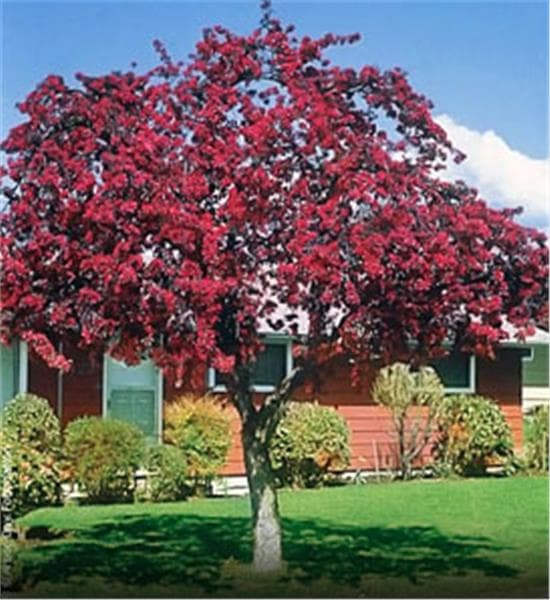
Prairifire Flowering Crabapple Tree
Malus 'Prairifire'
A vibrant, disease-resistant crabapple with stunning pink-red blooms and persistent fruit.
- Plant Type
- Flowering Trees
- Width
- 20 Ft.
- Height
- 20 Ft.
- USDA hardiness zone
- 4 - 8
- Sun requirements
- Full sun
- Water requirements
- Moderate
- Design image count
- 5
Design images (5)


Bring your vision to life
The design images above are drag-and-drop ready — place this plant on a photo of your own yard and see it before you plant it.
Create design onlineAbout Prairifire Flowering Crabapple Tree
Prairifire is an ornamental crabapple introduced in 1982 by Daniel F. Dayton at the University of Illinois. It combines reddish-purple young foliage, red-pink spring flowers, and dark purple fruit; the Morton Arboretum lists high resistance to several common crabapple diseases, while other horticultural references describe variation in mature stature.
## Form and seasonal interest
Use Prairifire as a flowering specimen or shade tree. A 20-foot height and spread are supported by Morton Arboretum’s mature-size listing; Trees and Shrubs Online describes the cultivar as a smaller tree under 4 metres, so mature size can vary with growing conditions and source. Spring bloom, foliage color, and persistent fruit provide interest across several seasons.
## Site
Grow in full sun in moist, well-drained soil. Monrovia’s profile provides additional cultivar care information, and the University of Illinois origin is documented in the cultivar history. Sources: [Trees and Shrubs Online](https://www.treesandshrubsonline.org/articles/malus/malus-cultivars-n-q/), [Morton Arboretum](https://mortonarb.org/plant-and-protect/trees-and-plants/crabapple-cultivars/), [Monrovia](https://www.monrovia.com/prairifire-crabapple.html).
## Maintenance
Prune to remove damaged or crossing branches and maintain a balanced crown. Rake fallen fruit as needed and monitor foliage for apple scab and other locally prevalent diseases.
## Pacific Northwest — PNW 590 (2023): Crabapple
The [trees-23 profile](https://extension.oregonstate.edu/gallery/fire-resistant-plant-profiles-trees) prints Malus species. Malus Prairiefire: Explicit source-body example, retaining named selection, taxonomic rank and trade-code scope. This is not an independent test or a transfer of the main profile's dimensions to the selection.
Source care: Low water use; Full sun to partial shade. Local planting restrictions may apply in fruit-growing areas. Keep the ornamental crabapple context and excluded M. floribunda explicit. Prairiefire/source spelling is reconciled with catalog Prairifire. [Conservation Garden Park](https://conservationgardenpark.jvwcd.gov/plants/3126/red-barron-crabapple) pairs Red Barron crabapple with printed Red Baron; the distinct orchard apple of that name is not covered. Named fruitless examples still require actual debris monitoring.
Profile reference data: Height: 15–20 feet; Spread: 15–20 feet; USDA hardiness zones: 4–8; Flowers: rose, pink, red, white; Bloom time: April–May; Fall color: several. These are profile-level source values, not independent measurements of each named example or edits to this record's scalar fields. Native-form availability, wildlife use and general deer-resistance statements are not automatic attributes of every selection.
The [2023 guide](https://extension.oregonstate.edu/catalog/pnw-590-fire-resistant-plants-home-landscapes) requires maintained, healthy, adequately watered plants and removal of dead/spent material. Keep the first 5 feet from the home free of plants. In the 5–30-foot zone separate planting groups by at least 10 feet, farther on slopes; avoid continuous rows and ladder fuels and keep tree branches at least 15 feet from the home. This is a regional source association, not a numerical flammability score or a claim of fireproofness. Older PNW editions and other regional ratings remain separate.