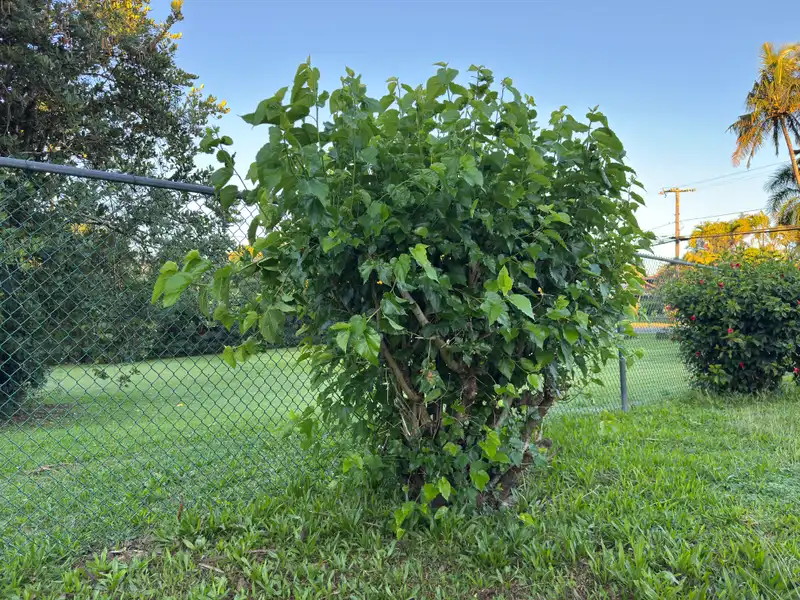
White Mulberry
Morus alba
A fast-growing, versatile shade tree with a rich history in silk production.
- Plant Type
- Edible Plants
- Width
- 30-50 Ft.
- Height
- 30-50 Ft.
- USDA hardiness zone
- 4 - 8
- Sun requirements
- Full Sun, Partial Shade
- Water requirements
- Medium
- Design image count
- 2
Design images (2)


Bring your vision to life
The design images above are drag-and-drop ready — place this plant on a photo of your own yard and see it before you plant it.
Create design onlineAbout White Mulberry
White mulberry is a rounded deciduous shade tree with glossy leaves that may be unlobed, mitten-shaped, or deeply lobed, even on one plant. Its inconspicuous spring catkins can develop into blackberry-like fruit in summer, but fruiting depends on the plant’s sex and pollination.
## Form and seasonal interest
The species can become a large tree: Oregon State describes it at about 50 feet, while NC State gives a mature height of 30–60 feet and spread of 30–50 feet. Green fruit changes to white, pink, red, or deep purple as it ripens, and birds feed on it; the fallen fruit can stain paving and vehicles. Leaves turn yellow in autumn. Male and female flowers usually occur on separate plants, though both have occasionally been reported on one tree.
## Site and climate
Grow in full sun or partial shade in moist, well-drained soil. It tolerates drought and a range of soil textures. NC State lists USDA Zones 4a–8b. The species has naturalized widely and hybridizes with native red mulberry; check local rules before planting, since some states restrict or prohibit it.
## Maintenance and safety
Allow room for a broad crown and shallow roots. If shaping is needed, prune in late fall or winter, when cut stems are less likely to bleed milky sap. Fruiting trees are best placed away from patios, paths, and parked cars. NC State notes low-severity toxicity from unripe berries and milky sap, while ripe fruits are eaten; avoid consuming unripe fruit. Sources: [NC State Extension Plant Toolbox](https://plants.ces.ncsu.edu/plants/morus-alba/common-name/white-mulberry/), [Oregon State University Landscape Plants](https://landscapeplants.oregonstate.edu/plants/morus-alba), and [University of Minnesota Extension](https://extension.umn.edu/natural-resources/forestry-and-wildlife/invasive-species/white-mulberry).
## Yavapai County — 2025 source scope and care
The [University of Arizona Yavapai County bulletin](https://extension.arizona.edu/sites/default/files/2025-03/FirewisePlants3-14-2025.pdf), page 2, lists Mulberry with the botanical cell Morus sp. and form T. It places this entry in its fire-resistant list. The matched catalog name is Morus alba. Unselected white mulberry is one tree representative of the broad Morus row. The older Everbearing/M.nigra record's individual identity remains qualified and is not used as the verified species match.
Source form codes: C=groundcover, G=grass, P=perennial, S=shrub, T=tree and V=vine. Printed names and form codes can include source spelling errors or historical taxonomic treatments; the source wording is retained separately from the catalog name and plant-specific habit.
The bulletin states that resistant plants require irrigation and frequent maintenance. It describes low shrubs or clean taller shrubs with little dead material. Maintain suitable moisture and spacing, remove dead growth and avoid continuous fuel; a regional list does not establish every selection's performance or local cold hardiness.
No plant is fireproof. Keep this Yavapai classification separate from Arizona UA, Utah, New Mexico, Idaho, Colorado and other source ratings and their placement, moisture and maintenance conditions.